WWI – Finding the Dead – Commonwealth War Graves Commission part 1

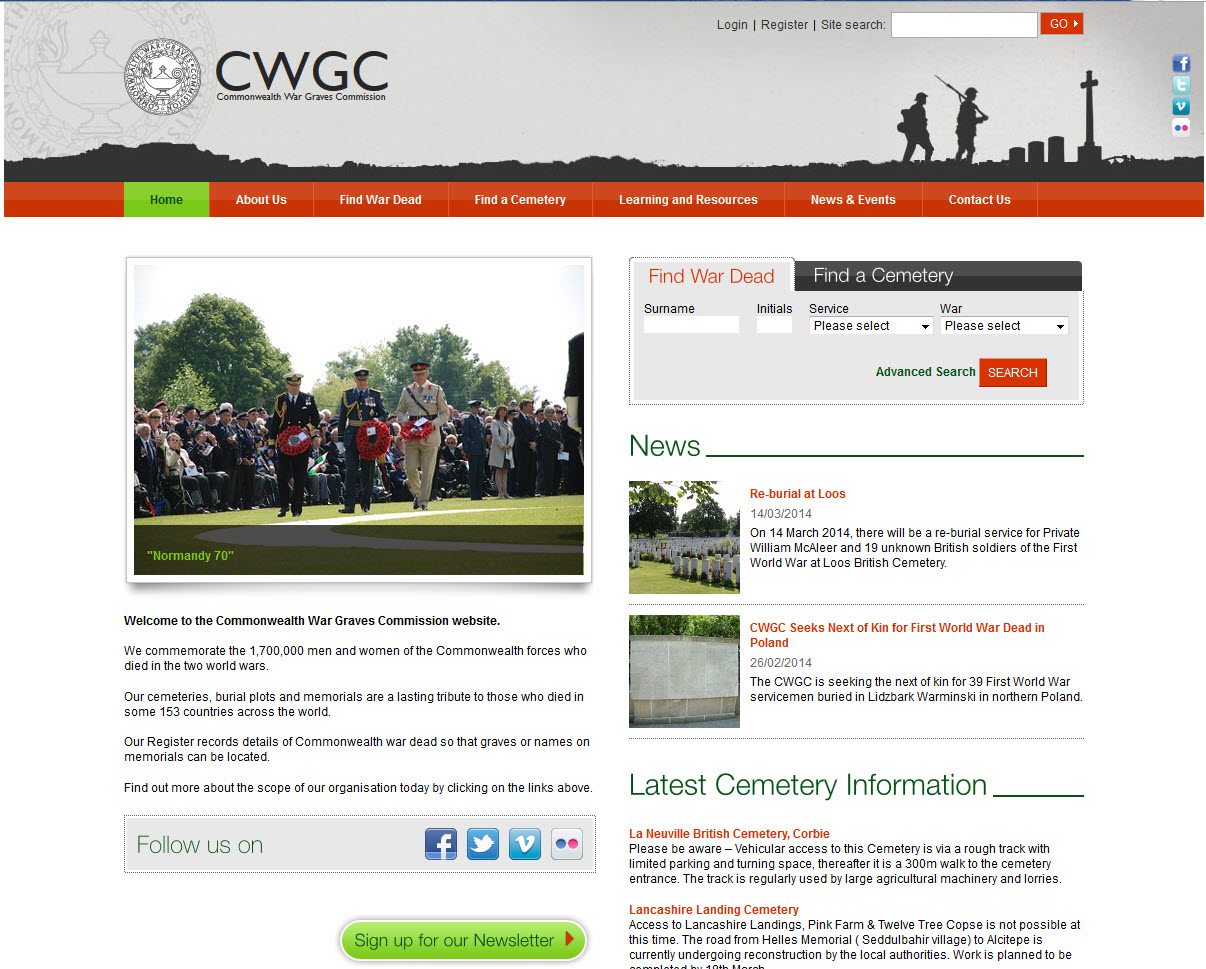
Home Page fro Commonwealth War Grave Commission Website with simple search box in upper right.
Home Page for Commonwealth War Grave Commission Website with simple search box in upper right.

I said in an earlier posting that this year I was going to have a special focus on World War One research. I have had a couple of postings mentioning new resources, but now I want to start explaining how to use the existing resources to trace your World War One ancestors and to put them into context.

Let’s assume your ancestor did not survive the war. The place to start is the Commonwealth War Graves Commission website at www.cwgc.org.

The Commonwealth War Graves Commission ensures that the 1.7 million people who died in the two world wars will never be forgotten. The Commission is responsible for marking and maintaining the graves of those members of the Commonwealth forces who died. It therefore cares for cemeteries and memorials in 23,000 locations, in 153 countries. One of the sad parts of these numbers is that for many the person in the grave is unknown, and for many on the memorials no identifiable remains have been recovered.

Don’t lose hope though. For the family historian the important resource provided is the index to the 1.7 million who have died in the two wars. There are 1,059,642 names from the WWI and 649,489 names from WWII.

Let’s start here by defining for this database what period is being searched when WWI is selected. The first day deaths are recorded is the 4 August 1914 with four deaths, while the last day for recording WWI deaths is 31 August 1921 when 24 deaths were recorded in England, India and South Africa. Remember that the war began on 28 July 1914 with Austria-Hungary’s declaration of war with Serbia. England declared war with Germany on 4 August 1914 and so four members of the British Armed Services lost their lives on the first day of the war. England declared war later against Austria-Hungary on 12 August 1914; against Turkey on 5 November 1914; and against Bulgaria on 15 October 1915.

Let’s jump right in and do a search, partially because that is what most people are going to do. From the home page you can do a simple search using: surname; initials; service; and war. For this illustration I am doing a search on the name Croudace, and I choose WWI. I have seven results listed, and this is definitely one of the benefits of an unusual surname. In this case I can examine all seven results by selecting the surname on each line in turn.
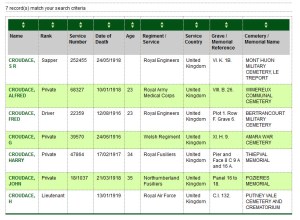
John Croudace - Northumberland Fusiliers son of Andrew John Croudcae and Jane Croudace
Search results for surname Croudace on Commonwealth War Grave Commission Website

The soldier I actually need is John Croudace.  The results shown are in a standardized format. What you hope and pray for is data in the Additional Information field for without it you may or may not be able to positively identify your serviceman or woman. In this case we learn that John Croudace is the son of John and Jane Croudace, of 14 Bentinck Street in Newcastle-on-Tyne. I have John with his parents (A.J. – Andrew John and Jane Croudace) and siblings at this address in the 1911 census. I have my serviceman.
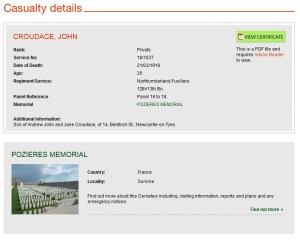
Details for John Croudace of the Northumberland Fusiliers, son of John and Jane Croudace

The standardized data fields are: name; rank; service number; date of death; age; regiment/service; grave reference, and the cemetery where buried or the memorial where his name is inscribed. There may also be the valuable additional information. The additional information was drawn from the soldiers paperwork where they often, but not always, named parents, or wives. This is especially valuable as many of those documents were destroyed by fire during World War II. I will come back to what has survived of these records in a later post. There can also be extensive information with photographs on the cemetery where the person in buried.
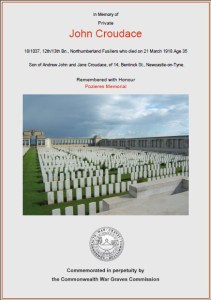
Presentation Memorial Certificate for John Croudace.

In the upper right corner of the casualty details box is a button for – view certificate. This is a very nice certificate to print to remember your serviceman or woman, and to insert into your research files. Please note that one key piece of information is missing from the certificate which would be vital if you are planning on visiting the cemetery or monument. What is missing is the grave reference number, or the panel number of the memorial.

We will take a closer look at this website in the next blog posting.

Digital Microfilm at TNA – changes coming – Army Lists as example

Digital Microfilm at TNA, currently Free, but changes are coming

Given my last post about the indexing of WWI war diaries, I was in this post going to explain how to download the war diaries that had already been scanned and were available as part of The National Archives website. I had downloaded war diaries in October 2013, but I can’t do it now. I thus spent the week learning a little more about what is happening regarding digital images at TNA.

Firstly, I learned that the war diaries are in the process of being digitized at a higher quality. They will then be repackaged, improved and put online again. I suspect with a different fee structure.

I also learned by reading the minutes of the TNA User Advisory Group that changes are coming to the Digital Microfilm currently available online for free. It is the Army Lists in WO 65 that are specifically mentioned in the minutes. I confirmed by contacting a committee member that changes are coming. Specifically WO 65 will be removed, repackaged and put online for a fee. Nothing was disclosed about what the repackaging what look like, what the fee would be, or when this would occur. It was suggested that if I wanted copies of the Army Lists for free that I should do it soon.

To get to the complete list of Digital Microfilm click here. This will take you to a description page and a long list (getting shorter) of digital microfilm that you can download free from a variety of record groups. Scroll to WO 65 – Printed Annual Army Lists. The published army lists begin here in 1754 with WO 65-1 and end chronologically with 1878-79 WO65/163. However, at the end of the chronological lists are an additional five films of British American Half Pay lists and Foreign Corps. What is different about these printed Army Lists is that they are the ones that were actually used by the War Office. These volumes are annotated, often indicating changes for you to look for in the following year.

The published annual Army Lists is often the first primary source you will use to reconstruct the promotions for any Army Officer.  It is thus a valuable source. I am not suggesting that you download every volume available. These can be very big files. What I am suggesting is that you may want to consider downloading the volumes for any specific period in which your ancestor/s may have served. In addition to that I am also downloading sample volumes from other periods so if I later find or suspect another family connection I can dip into the lists for free. I understand that there will be a charge in the future.

Have a look at the rest of the digital microfilms to see what others may be of interest to you and get them now. Some of them are fully indexed in the Discovery catalog – WO 76 – Records of Officers Services. As an outsider this would be another obvious one for a commercial partner to index, slice and dice and of course then charge you to access the record.

Have a look at the Digital Microfilms, which are currently free and see what might be beneficial to your research.

WWI: Operation War Diary – Your Help Wanted

Operation War Diary - Joint project between TNA, IWM and Zooniverse to index WWI Diaries
Operation War Diary – Joint project between TNA, IWM and Zooniverse to index WWI Diaries

WWI: Operation War Diary – Your help wanted

Operation War Diary is a new joint project between The National Archive (providing the documents), the Imperial War Museum (providing the historical expertise) and Zooniverse (providing the technology community software) is recruiting citizen historians to index these war diaries. The project is online at www.operationwardiary.org.

During WWI each unit kept a war diary. There are over 1.5 million pages within these diaries telling the stories of what was happening on any given day during the war. This is where you have the opportunity to put your soldier into context. The diaries originated as a result of Field Regulations Part II issued in 1909 and reprinted in 1913, stipulating the purpose of the war diary and how the diary was to be completed. However, every diary is different. The goal of this new project is to “classify each page of every diary”.  Indexing the war diaries will reveal questions about: military activity; people; weather; army life; and casualties.

The website provides a Field Guide to the diaries with examples of the different pages – cover, diary, orders, signal pads, reports and other documents (e.g. maps) and lists what is hoped will be tagged and indexed on each of these pages. There is a 10 minute tutorial on how to tag and index, which is very good. You will need to register first and then you can start tagging. Currently 31 diaries are online in various levels of completion. The site states that eventually everything from Operation War Diary will be available to everyone free of charge.

The stated purpose is to “classify each page of every diary”, however on the About Us page is states that The National Archives has digitized the war diaries of the units under the command of the British and Indian cavalry and infantry divisions on the Western Front. This makes me wonder if other Fronts such as Gallipoli or Mesopotamia will be included later. Personally I hope so as I have a soldier dying at El Kut in Mesopotamia and I would like to read that war diary.

There is also a discussion section where images can be posted of problem pages, help requests, or exciting finds. This is a very active section, for example 12 images with questions posted within the last hour.

I have read some war diaries in the past, but logging in and starting to tag the data really helps you appreciate the depth of details that are here about the lives of our soldier ancestors. The process was simple, fun and educational. If you have WWI ancestors, come join us in this worthwhile project.

WWI Centenary Preparations by Commonwealth War Grave Commission

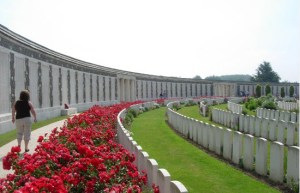
Tyne Cot Memorial, Ypres, Belgium

WWI Centenary Preparations by Commonwealth War Grave Commission
I mentioned in my opening post for 2014 that this year I would be taking a look at some of the WWI military records available to family historians in detail. The Centenary is going to be a big event over the next five years as we recall what happened and the effect it had on our families. One of the institutions highly involved in the centenary is the Commonwealth War Gave Commission (CWGC). We will learn more about their records later.

The Commonwealth War Grave Commission maintains and cares for cemeteries, monuments and memorials in over 24,000 locations in 150 countries, all commemorating Commonwealth men and women who have died in a branch of the military service since the start

of WWI. The sites may be a single headstone or a large cemetery such as Tyne Cot at Ypres in Belgium with over 7,500 headstones. Visitors to these sites have been increasing and are expected to increase dramatically with the centenary.

To prepare the CWGC has identified five “iconic” sites in France and northern Europe. These are Tyne Cot (Ypres, Belgium), St. Symphorien (Mons, Belgium), Nieuwpoort Memorial (Flanders, Belgium), Menin Gate (Ypres, Belgium), and Island of Ireland Peace Park (Messine, near Ypres, Belgium). The preparations include: replacing and re-engraving of headstones; renovating and replanting borders and gardens; replacing panels and renewing paint in the engraved names on memorials, and much more.

More details about the preparations can be read in a story entitled “War Graves commission face major WWI challenge” from December 28, 2013 issue of The Scotsman.
The CWGC publishes a monthly newsletter keeping readers informed about what is happening around the world. One story in the January 2014 issue that caught my attention referred to a grave site being located for a British Airman – Second Lieutenant Philip Frederick Cormack, 204th Squadron, Royal Air Force who until now has been commemorated on the Arras Flying Services Memorial (meaning there is no known grave). He is in fact buried in the French Military Cemetery in Machelen, East-Flanders in Belgium. The CWGC continues to identify and locate the bodies of the fallen.

Thanks to Chris Paton at The British GENES Blog (Genealogy News & EventS) for bringing both these items to my attention.