Book Review: Tracing Your British Indian Ancestors: A Guide for Family Historians

Yesterday I gave 4 lectures at the Western Australia State Library in Perth, WA. I had a number of questions about British families that came to Australia after spending time in India. I thought this book would be of interest to readers.
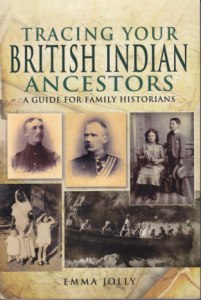
Tracing Your British Indian Ancestors: A Guide for Family Historians. By Emma Jolly. Published by Pen & Sword Family History, 47 Church Street, Barnsley, South Yorkshire S70 2AS, UK. www.pen-and-sword.co.uk. £14.99. US Distributor: Casemate Publishing, 1016 Warrior Road, Drexel Hill, PA 19026. www.casemateathena.com. 2012. xviii, 184 pp. Illustrations, index. Softcover. $24.95

Terms and geography need to be defined for best use of this important book. “British Indian” here refers to British citizens and Europeans who worked for the East Indian Company (generally as officers in the army), plus Anglo-Indians of mixed descent from the union of white British or European males and Indian women. Those of mixed descent were often segregated and discriminated against, yet they made an essential contribution to British India and are found in most British India records. Geographically, the area covered by this book, includes modern-day India, Pakistan, Bangladesh and Burma (modern Myanmar). Other areas that may be encountered in India-related records are St. Helena, Iraq, Iran (formerly Persia), Aden, Kuwait, Sri Lanka (formerly Ceylon), Singapore, Malacca, Penang Prince of Wales Island, Java, Sumatra (Bencoolen / Fort Marlborough) and China (Macao and Whampoa). In reality this means most places east of the Cape of Good Hope that had British connections.

The book covers the time period of 1600, when the East India Company received its Royal Charter from Queen Elizabeth I, to the present.  It begins with a chapter on how to get started, which is actually a must read, especially for North American researchers, because even though the majority of the records needed will be in England, they are not in the places even most English researchers would expect to look. The largest collection of original material is the India Office Records at the British Library, with other collections at The National Archives, National Army Museum, National Maritime Museum, School of Oriental and African Studies, or the Society of Genealogists, all in London, with a few other collections scattered around the British Isles and India. The most important society is FIBIS, Families in British India Society, which provides lots of indexes, resources and an excellent wiki.

The following three chapters present the increasing role of the East India Company from 1600 through the Indian Mutiny in 1857, its subsequent loss of control to the British government and the period of the British Raj from 1857 through independence in 1947. The focus is on historical context, but the voluminous record collections applicable to the period and their location are highlighted.

The next five chapters focus on five aspects of the Indian life where the British were heavily involved, and which created most of the records of the British Indians. These are: the servicemen and women of the East India Company’s Armies, the Indian Army, the British Army in India and the Royal Indian Air Force; merchants and ships; religion, cemeteries and schools; railways; probate records. Key throughout these chapters is the clear defining of what records and indexes to examine, and where. They identify which resources are available online, which are published and available for purchase, and what will need to be examined in person or onsite. Each of the groups of people and their records is also placed into historical context.  A closing chapter addresses Indian independence and life after 1947. Throughout the book there are a number of short case studies showcasing the biographical information and lives that can be reconstructed from the records of our British Indian ancestors.

India developed from a company outpost into the crown in the British Empire with many individuals over the centuries from the British Isles serving in its government, its military or developing its industry. Many have ancestors who moved there temporarily or permanently.  This well written research guide is a must for anyone seeking to explore their British Indian connections.

Genealogy at a Glance: English Research (or Irish or Scottish) – How to purchase in Australia and New Zealand

Genealogy at a Glance - English Research by Paul Milner
Genealogy at a Glance – English Research by Paul Milner

I have exciting news for Australian and New Zealand researchers. As I lecture in Australia there is strong interest in Genealogy at a Glance series of laminated help sheets published by Genealogical Publishing Company. I wrote the English Research guide and have a few remaining copies but expect to sell out of them at my next venue in Perth on Saturday. Brian Mitchell wrote the guide for Ireland, and David Dobson wrote the guide for Scotland, all copies sold out.
Here is how to purchase them directly from the publisher at a much reduced price from the one listed on the company’s website.   These are 1st class international postage paid prices, especially for my blog readers:
1 Genealogy at a Glance        $20
2 Genealogy at a Glance        $35
3 Genealogy at a Glance        $50
You can order via email to ecollins@genealogical.com
You can mail an order to: Genealogical.com, 3600 Clipper Mill Road, Ste 260, Baltimore, MD 21211, USA
You will need to provide either a check in US currency or credit card information.
I apologize to the participants in Brisbane who wanted to purchase additional Genealogy at a Glance laminated folders and I hope you will be happy with this arrangement that I managed to make with the publisher.

Unlock The Past Genealogy Cruise – Buried Treasures: What’s in the English Parish Chest?

We are now into day four of the Unlock the Past Genealogy Cruise. The lecture that has opened the most eyes with excitement so far has been “Buried Treasures: What’s in the English Parish Chest?”  This lecture examines the civil functions of the English parish, highlighting the records it may provide: the names of the fathers of illegitimate children; the place of origin in the settlement records; those receiving indoor or outdoor relief from the parish; the names of parish officials; the names of those paying property taxes, or being excused because they are too poor. English Parish Chests contain lots of records that participants did not know existed. For many, these could be the resources they need to break down their brick walls.
Once home after this 10-day genealogy intensive in the beautiful Pacific, participants will be able to check out parish records as a new and possibly rich resource for their research.

Hornsby RSL – New South Wales – A Different Audience

Yesterday I gave 4 presentations with a Scottish focus to a group of 70-80 genealogists at the Hornsby RSL (Returned Service League) Club in the northern suburbs of Sydney. To get a sense of the audience my opening question was – How many people can identify their Scottish ancestors and put them physically on the ground in Scotland? Everyone put hands up. I knew immediately that I had a different audience than I typically find in the U.S.

In the States, when asking a similar question, I will often only get only a handful of participants who can physically locate their ancestors in Scotland. These folks have come to learn how to jump the Atlantic and locate their ancestors.

The participants in Hornsby knew where their Scottish ancestors came from, and  they  were familiar with a wider variety of research tools. Their questions were thoughtful, and they were well prepared to go deeper to break down the brick walls in their research.  At the end of the day, they seemed a little overwhelmed but they were clearly ready to immediately use the more complex (and sometimes less known) research tools we discussed.

A thoroughly good day for all.


Speaker Nerves

As speakers we all get nervous before an event, especially a big one. My nervous energy is high right now. I leave this afternoon for 4 weeks in Australia. In that time period I will give 15 different lectures, doing 38 presentations. See my calendar if you want to know when, where and what topics. I will not be home in between. If I don’t have the document image, or scan with me I will do without it. In the old days when everything was on overhead transparencies and you got on that plane everything was set in concrete. Now with powerpoint we tinker with the presentation, making adjustments, fine tuning the transitions and content right up to the time it is given.

The reality is that I know where the strengths and weakness are in my presentations because I am the presenter, and that should be the case. I know what I am having to leave out because of time constraints. From the audience perspective the issue is can I cover the subject in a clear and instructive manner. I know I will do that. So why the stress? Because as speakers we can and always want to do the best job that we can do. Plus we want to be continually improving.

Since I start the trip with a genealogy conference on a 10 day cruise I know internet access will be limited. However, I hope to share observations about how things are done a little differently ‘down-under’ during this trip. So I hope you do follow along.

Now its time to finish packing the camera, computer and the suitcase.

Blogger Trail leads to online Irish Civil Registration Map

It is always fascinating following the trail laid down by the Blogger network for you never know where it will take you and what gem you will find. This morning I logged on to read John Reid of Anglo-Celtic Connections with a post celebrating the third anniversary of Ruth Blair’s blog – the Passionate Genealogist. I followed the link to Ruth’s blog and scrolled down to read a post from January 18 entitled Ruth’s Recommendations.

In Ruth’s list was a link to a free Handy Map of Irish Civil Registration Boundaries available through FindMyPast.ie. What a delightful map it is. Yes, similar maps of civil registration boundaries are available in print, but this is the best that I have seen online and in color. The result is that it got clipped and inserted into my updated lecture on Finding Your Ancestors in Ireland, which is one of the 38 presentations I will give on my upcoming Australia lecture tour (leaving the US this coming Wednesday).

Yes, I did leave the FindMyPast.ie logo on the map to give them credit, and to also remind me and my audience where I got the map from in the first place.

Thanks for the lead.

Book Review: Discover Scottish Land Records

Discover Scottish Land Records. By Chris Paton. Published by Unlock the Past, P.O. Box 119, St. Agnes SA 5097, Australia. http://www.unlockthepast.com.au. 2012. 68 pp. Illustrations, index. Softcover. AU$20
I liked this book, a lot, and can highly recommend it for those seeking to put their Scottish ancestors on the ground in Scotland, and find the associated records. The book focuses on place. It even encouraged me to go back to my own book, A Genealogists Guide to Discovering Your Scottish Ancestors, to remind myself what I had discussed and what I had not.

The book begins by discussing where your ancestors were. It examines the records you may already be familiar with, such as: vital records; parish records; census records; street directories; phone directories; electoral registers; valuation rolls; burgh assessment rolls; earlier tax and valuation rolls; and newspapers. In each of these record groups the goal here is to identify where your ancestors were living or working, so looking for specific street addresses or names of farms, etc. The book moves on to put those places into context using maps, the Statistical Account of Scotland, gazetteers, etc.

It is the next two sections of the book addressing land tenure and inheritance that I thought were especially good, taking me further into my understanding of Scottish records and importantly bringing me up to date on how to access these materials and learning  what has changed legally within the last decade. The section on land tenure begins with a very good overview of how Scottish laws have developed over time, describing feudalism and the use of charters. This provides the context for how and why the records developed the way they did. There is a good discussion of sasines, liferents and trusts, Registers of Scotland, Register of Deeds, rental records, the role of the tacksman, and ultimately the end of feudalism in 2004 (yes, you read that correctly  – 2004). The chapter on inheritance explains: the differences between moveable and heritable estates; apparent heirs (not the same as the English phrase – heir apparent); the Services of Heirs, with the differences between Special Services (special retours) and General Services (general retours), giving examples from the indexes; the concept of Precept of Clare Constat; and then a good explanation of the different types of heirs that you may run across in the records. The book concludes with a good glossary and a brief bibliography.

If you have found your Scottish ancestors in the basic record groups and want to go to a deeper level in your research and seek your ancestors on the land then I can highly recommend this slim but well written, practical guide to these records.

Scottish Course at the Institute of Genealogy and Historical Research – June 9-14, 2013

There are a few places left in the Scottish track at the Institute of Genealogy and Historical Research being held Jun 9-14, 2013 at Samford University in Birmingham Alabama. This is an intense week focusing just on Scottish Research. If you are interested you need to act soon as the class is filling up. Have a look at the following class schedule. If you are interested go to IGHR 2013 to Register.

Monday

  • 8:15 a.m. – 8:30 a.m.: Class Orientation/Introductions
  • 8:30 a.m. – 9:45 a.m.: Scotland – Definitions, Sources, Repositories and Processes
  • 9:45 a.m. – 10:00 a.m.: Morning Break
  • 10:00 a.m. – 11:15 a.m.: Scottish Emigration to North America
  • 11:15 a.m. – 12:45 p.m.: Lunch
  • 12:45 p.m. – 2:00 p.m.: History of Scotland
  • 2:00 p.m. – 2:45 p.m.: Afternoon Break
  • 2:45 p.m. – 4:00 p.m.: Internet: Commercial Sites (Computer Lab)

Tuesday

  • 8:30 a.m. – 9:45 a.m.: Internet: Free Sites (Computer Lab)
  • 9:45 a.m. – 10:00 a.m.: Morning Break
  • 10:00 a.m. – 11:15 a.m.: Find the Correct Place: Maps and Gazetteers
  • 11:15 a.m. – 12:45 p.m.: Lunch
  • 12:45 p.m. – 2:00 p.m.: Civil Registration
  • 2:00 p.m. – 2:45 p.m.: Afternoon Break
  • 2:45 p.m. – 4:00 p.m.: Making Sense of the Census

Wednesday

  • 8:30 a.m. – 9:45 a.m.: Church Records for B/M/D
  • 9:45 a.m. – 10:00 a.m.: Morning Break
  • 10:00 a.m. – 11:15 a.m.: Kirk Session and Poor Relief Records
  • 11:15 a.m. – 12:45 p.m.: Lunch
  • 12:45 p.m. – 2:00 p.m.: Inheritance: Wills and Executries
  • 2:00 p.m. – 2:45 p.m.: Afternoon Break
  • 2:45 p.m. – 4:00 p.m.: Inheritance: Transfer of Land and Buildings

Thursday

  • 8:30 a.m. – 9:45 a.m.: Burghs and Their Records
  • 9:45 a.m. – 10:00 a.m.: Morning Break
  • 10:00 a.m. – 11:15 a.m.: Occupation Records
  • 11:15 a.m. – 12:45 p.m.: Lunch
  • 12:45 p.m. – 2:00 p.m.: Scots in the British Military — Part 1
  • 2:00 p.m. – 2:45 p.m.: Afternoon Break
  • 2:45 p.m. – 4:00 p.m.: Scots in the British Military — Part 2

Friday

  • 8:00 a.m. – 9:00 a.m.: Overlooked Sources — 17th and 18th Centuries
  • 9:00 a.m. – 9:30 a.m.: Morning Break
  • 9:30 a.m. – 10:30 a.m.: Overlooked Sources — 19th and 20th Centuries
  • 10:30 a.m. – 10:45 a.m.: Mini-Break
  • 10:45 a.m. – 11:45 a.m.: Planning your Trip to Scotland
  • 11:45 a.m. – 12:00 p.m.: Certificates and Farewells

Book Review: Marriage Law for Genealogists

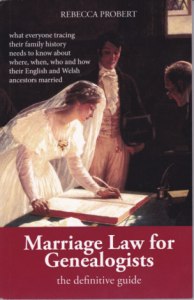
Marriage Law for Genealogists: The Definitive Guide. By Rebecca Probert. Published by Takeaway Publishing. Copies obtainable directly from the author at books@takeawaypublishing.co.uk or on Amazon. 2012. 160 pp. Illustrations, index. Softcover. $14.99.

Here is the definitive guide to understanding marriage law in England and Wales, from 1600 to the present. This book is written for genealogists; it is not a legal text. It is not a light read, but it is clearly written and is certainly worth the effort in reading all the way through to get a complete, accurate picture of marriage laws before it is used as a research tool to look up specific questions. .

Ms. Probert is a genealogist and Professor of Family Law at Warwick University and a leading authority of the history of marriage laws of England and Wales. She strongly disputes the writings of other historians such as John Gillis, Lawrence Stone and Brian Outhwaite who have all written extensively on marriage laws and practice, divorce, cohabitation, and children out of wedlock. Their books have guided genealogists, including me, who write about marriage laws. Probert contends that the errors and assumptions of these authors create confusion for genealogists. In my opinion, she succeeds in clarifying the changing rules of marriage from 1600 to the present.

The book addresses five questions.  (1) “Whether and Why” your ancestor married deals with the likelihood of any given couple having gone through a valid ceremony of marriage. (2) “Who” examines who could marry, and whom they could or could not marry. (3) “How” examines the formalities required for a valid marriage, plus what that means for Roman Catholics or Protestant Dissenters. (4) “When” looks at the age at which couples could and did marry, when parental consent was required and who could object; plus it examines the seasons, days and hours when marriage could be and were celebrated. (5) “Where” moves beyond the legal requirements to large scale genealogical studies that provide guidance to family historians on where they may need to look for the marriages of their ancestors. Throughout the book there is a continual discussion of important key conditions (changing over time) that make a marriage valid, void, and voidable. Additionally there is frequent discussion about what in the law was required versus what was directory. Included in the text are sample questions typically raised by genealogists, and these are answered clearly.

This book will greatly add to your understanding of marriage laws and help you in your research. It is a must for anyone seeking to understand the laws or struggling to find a particular marriage ancestor’s marriage. (Unique laws apply in Scotland and Ireland so don’t apply the laws here to other places, but make use of the framework presented here as an excellent structure for examining marriages in other locations.) If you think you know everything you need to know about English marriage laws then take the authors quiz

There is one small distraction to the book. I have on my office wall a reprint of the painting Signing the Register depicting a nineteenth century wedding by Edmond Blair Leighton, a very familiar painting. The publisher has reversed part of the image of this painting for the cover of the book.  Thus, the bride appears to have her wedding ring on her right hand and is using a quill to sign the register with her left hand, something that certainly was frowned upon in the time period of this painting.