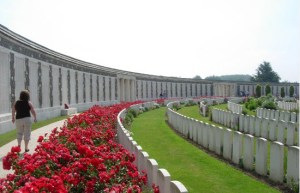
WWI Centenary Preparations by Commonwealth War Grave Commission

Tyne Cot Memorial, Ypres, Belgium

WWI Centenary Preparations by Commonwealth War Grave Commission
I mentioned in my opening post for 2014 that this year I would be taking a look at some of the WWI military records available to family historians in detail. The Centenary is going to be a big event over the next five years as we recall what happened and the effect it had on our families. One of the institutions highly involved in the centenary is the Commonwealth War Gave Commission (CWGC). We will learn more about their records later.

The Commonwealth War Grave Commission maintains and cares for cemeteries, monuments and memorials in over 24,000 locations in 150 countries, all commemorating Commonwealth men and women who have died in a branch of the military service since the start

of WWI. The sites may be a single headstone or a large cemetery such as Tyne Cot at Ypres in Belgium with over 7,500 headstones. Visitors to these sites have been increasing and are expected to increase dramatically with the centenary.

To prepare the CWGC has identified five “iconic” sites in France and northern Europe. These are Tyne Cot (Ypres, Belgium), St. Symphorien (Mons, Belgium), Nieuwpoort Memorial (Flanders, Belgium), Menin Gate (Ypres, Belgium), and Island of Ireland Peace Park (Messine, near Ypres, Belgium). The preparations include: replacing and re-engraving of headstones; renovating and replanting borders and gardens; replacing panels and renewing paint in the engraved names on memorials, and much more.

More details about the preparations can be read in a story entitled “War Graves commission face major WWI challenge” from December 28, 2013 issue of The Scotsman.
The CWGC publishes a monthly newsletter keeping readers informed about what is happening around the world. One story in the January 2014 issue that caught my attention referred to a grave site being located for a British Airman – Second Lieutenant Philip Frederick Cormack, 204th Squadron, Royal Air Force who until now has been commemorated on the Arras Flying Services Memorial (meaning there is no known grave). He is in fact buried in the French Military Cemetery in Machelen, East-Flanders in Belgium. The CWGC continues to identify and locate the bodies of the fallen.

Thanks to Chris Paton at The British GENES Blog (Genealogy News & EventS) for bringing both these items to my attention.
2014 Plans for the Future

2014 Plans for the Future

In my last post I reflected on the happenings of 2013. In this post I will use the same themes and share what I have planned for 2014.

Blog and Writing – On the blog I will continue to highlight and review new online and print resources. If there is a topic that you would specifically like to know about let me know and I will see how if I can point you towards good resources.

In addition I want to focus on the fact that 2014 is the centenary of the start of World War One. Almost anyone with family connections in the British Isles in 1914 will have someone who served in the war or was affected by the war. All the new online indexes are making it so much easier to find family members who served in one of the branches of the armed services or the auxiliaries. What I am finding though is that students don’t appreciate what they have found, what the records contain, or what clues they provide to go to the next step. I plan on examining some of the records in detail and demonstrating how to go further.

I am also working with a good friend, a technologically savvy genealogy blogger, to provide mutual support to write for our blogs on a consistently regular basis. The hope and expectation is that we will both post on a more consistent schedule.

In other writing, I am working on a manuscript explaining the records within the English Parish Chest, to be published by UnlockThePast. I will let you know when my new book, already with the publisher – Discovering English Parish Registers becomes available.

I will also continue doing my reviews for the Federation of Genealogical Society’s FORUM magazine, plus for the newsletter of the British Interest Group of Wisconsin and Illinois (BIGWILL).

Genealogical Speaking – I teach an English track and a Scottish track at the Institute of Genealogy and Historical Research at Samford University in Birmingham, Alabama as part of a three year cycle with David Rencher teaching the Irish track this year. This therefore is my year off while David teaches.

Instead I will be teaching a week long program for the 2014 British Institute – Scottish Research: Understanding the Fundamentals and Beyond – October 20-24 in Salt Lake City for the International Society for British Genealogy and Family History. Plan on coming to join me for what will be a great learning opportunity. I will also be lecturing at both national conferences – National Genealogical Society conference in Richmond, Virginia (May 7-10) and the Federation of Genealogical Societies Conference in San Antonia, Texas (Aug 27-30). In addition there will be a number of regional and local events. Keep an eye on my schedule for a more complete itinerary.

Personal Research – I hope to make some time for my own research, especially my Milner, Finnigan and Doran lines. I will try to share some of their stories. I will be using my World War One focus to explore and learn more about my many family members who served and died during the war.

Please Join Me in this journey by reading my blog regularly, which you can do by subscribing to the RSS feed or subscribing to an email version of this blog. If you know fellow researchers with a British Isles interest do not keep me a secret, let them know you are reading my blog and suggest they may enjoy it.

Happy Hogmaney to all my readers. Let’s all enjoy 2014 and do good research.

2013 Reflection

Happy New Year.

The New Year is a time to reflect upon the past year and to look forward to the new. In this post I am going to reflect upon 2013, and I will make a new posting for what is planned or hoped for in 2014.

2013 has been a great year in many ways.

Blog and Writing– One obvious genealogical activity has been the creation of this blog. I started it in January 2013 in preparation for the trip to Australia. My focus has been to review and highlight new resources for British Isles research. I have occasionally shared research about my own ancestors along the way.

My Genealogy at a Glance: English Research, published by Genealogical Publishing Company late in 2012 has been selling well throughout the year. I have written the manuscript for Discover English Parish Records which will be published by UnLockthePast publishing early in 2014. I will let you know when it is released.

I continue to write book reviews for The FORUM, the quarterly newsletter of the Federation of Genealogical Societies, and the bi-monthly newsletter of the British Interest Group of Wisconsin and Illinois. This activity is a large part of my personal learning process.

Genealogical Speaking – This has been a bumper year with 80 presentations given to audiences on three continents, in three countries – United States of America, Australia and England. Let me give a few more details.

The first overseas trip to Australia started with an UnlockthePast cruise conference from Sydney to Noumea and Fiji, though our cruise never made it to Fiji (electrical trouble!). This was followed by lectures in six cities: Sydney; Brisbane; Perth; Adelaide; Canberra and Melbourne. The trip included 39 lectures covering a wide variety of English, Scottish and Irish research. There was also lots of interaction with enthusiastic and knowledgeable British Isles researchers.

The second overseas trip was to the Exodus: Movement of the People international conference in Hinckley, Leicestershire, England where I gave two presentations on Irish and Scottish Migration to North America.

In the United States I taught a week of classes on Scottish Research at the Institute of Genealogy and Historical Research at Birmingham, Alabama. This along with lectures given at the Federation of Genealogical Societies national conference, regional and local events has made it a great year.

Personal Research – this has focused primarily on my Milner line. I learned about my Australian convict James Milner and got to visit the area of Tasmania where he lived. I wrote about this visit in my blog earlier this year. On the trip to England I spent three wonderful days visiting churches and communities where my ancestors come from in Kent. I also got to photograph parish registers still held by two Roman Catholic Parishes, looking for my Finnegan and Doran ancestors in west Cumbria. Nevertheless, with all the speaking and writing there is never enough time to do the personal research that I would love to be doing.

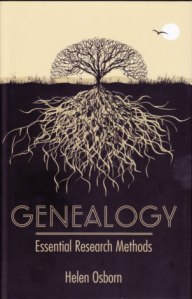
Book Review: Genealogy – Essential Research Methods by Helen Osborn

Genealogy: Essential Research Methods by Helen Osborn

Genealogy: Essential Research Methods. By Helen Osborn. Published by Robert Hale, Clerkenwell House, Clerkenwell Green, London EC1R 0HT, UK. 2012. 272 pp. Hardcover. ₤14.99

Finally, here is a research methodology book written from a British perspective. Yes, there have been a few in the distant past but this one is the first to appear in many years and it is catching up with genealogical scholarship. The book openly acknowledges that in the British Isles the emphasis is on explaining and describing the records, not how to pull everything together is one tight thoroughly researched process.

The book provides advice and inspiration on methods and problem solving skills to help the family historian understand what successful professionals do to get results and why they should be copied. The book is divided into ten chapters: (1) provides an overview of the common challenges we all encounter; (2) explores the search process and examines an effective search actually consists of; (3) and (4) look at how you can go about finding the right source and start to understand their context; (5) asks you to consider whether someone else has already solved your problem for you, and where you can look to find out; (6) shows you how to analyze a document to make sure you really are making the most of your sources once you find them; (7) looks at problem-solving using analysis and a research plan; (8) is about recording your information correctly; (9) is all about organization and presenting your results; (10) discusses the important question of how to prove family connections by using good proof standards in your research.

The book does an excellent job of getting the reader to think about what the research process is and how it can be improved and understood better to get good results.

I liked the book, it gets the reader thinking about how to improve what they do, but in some ways it lets the researcher off the hook. Let me explain. The one part of the book I found myself reacting negatively to deals with documentation and citing sources. Ms. Osborn gives three examples of the same family group sheet: undocumented; documented; and what she calls hyper-documented. The implication to the beginner by the choice of these titles is that the documented is satisfactory, when in reality it is not. The so called hyper-documented is what would be regarded as well or properly documented and would leave a good trail for researchers to follow. The text suggests the hyper-documentation is an extra step encouraged for those planning to publish, not a standard to be encouraged for all good researchers.

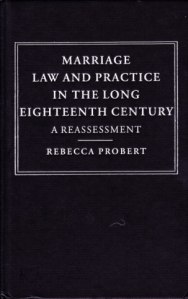
Book Review: Marriage Law and Practice in the Long Eighteenth Century – A Reassessment by Rebecca Probert

Marriage Law and Practice in the Long Eighteenth Century – A Reassessment by Rebecca Probert

Marriage Law and Practice in the Long Eighteenth Century: A Reassessment. By Rebecca Probert. Published by Cambridge University Press, The Edinburgh Building, Cambridge CB2 8RU, UK. www.cambridge.org. 2009. xii, 358 pp. Index. Hardcover. $113.

 This book radically changes our understanding of English marriage law, destroying most of what has been taught by historians and genealogists regarding marriage law in the past. This book is one volume in a series entitled Cambridge Studies in English Legal History and is therefore not a light read, but is certainly worth the effort. If you want an overview of Ms. Proberts’ arguments then read her Marriage Law for Genealogists: The Definitive Guide that I reviewed earlier. If you want more details including the specifics on the case law read this volume.

 Ms. Probert is a genealogist and Professor of Family Law at Warwick University, a leading authority of the history of marriage laws of England and Wales and it clearly shows here. Her arguments in this book for her case are through and backed up by legal, historical and genealogical research which makes the book fascinating to read.

A very strong case is made that the 1753 Lord Hardwicke’s Act did not constitute a radical break with the past, but rather it was a transition from canon law to English law. In many ways the new Act focused on enforcing what was already supposed to be happening and as the formal title suggests “Act for Preventing Clandestine Marriages” it was primarily aimed at one particular practice – ending Clandestine Marriages.

 The book focuses on the decades before and after the Act and how the contemporary people, church and legal establishment viewed marriage. It is vitally important to use contemporary sources for it is the legal establishments in both England and America that have really muddied the waters and led many historians astray.

 The book examines in detail the misunderstandings around contract per verba de praesenti, clearly defining in the process what constituted a marriage in the eyes of the church and the law. It addresses other perceived marriages practices, tracing the origins of each into the historical literature and destroying each along the way. Ms. Probert moves on to explain what a clandestine marriage is and why it was such a problem for the establishment, and for the people involved. Once defined the book looks at the passage of the Act, what the law said and what effect it had on practice. Examined are the terms of Act; contracts to be unenforceable; preliminaries to the marriage; parental control; the ceremony; registration; penalties; exemptions. It would have been a nice addition if a full copy of the Act had been included in the book.

The book concludes by examining the success of the Act, how it was interpreted afterwards by the judicial system and what the response was at the time by the non-Anglicans.

For the genealogist three sets of records are used to support her case regarding marriage practices: specific cohorts of couples drawn from baptismal registers in a variety of locations around England and Wales; settlement examinations (Bradford-on-Avon, Wiltshire); and a rare parish listing (1782 Cardington, Bedfordshire).  

The book is heavily footnoted throughout citing numerous legal, historical, genealogical and social texts and studies. These provide lots of alternative viewpoints. However, this reviewer thinks the arguments have been made soundly, are strongly supported, and all genealogists should rethink what they have been taught about English marriage laws and practices in the eighteenth century. This is a good read


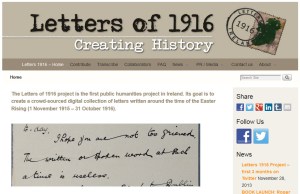
Letters of 1916: Creating History

Letters of 1916: Creating History Project from Trinity College Dublin

Letters of 1916: Creating History

Do you have letters to or from anyone in Ireland written in 1916. Then you may want to share them with the Letters of 1916: Creating History project at http://dh.tcd.ie/letters1916/

Quoting from the website’s home page – “The Letters of 1916 project is the first public humanities project in Ireland. Its goal is to create a crowd-sourced digital collection of letters written around the time of the Easter Rising (1 November 1915-31 October 1916).”  In the first two months of the project over 500 letters were uploaded from both national institutions and private collections. The Letters 1916 team is identifying, digitizing and preparing hundreds more for uploading.

The project is being coordinated by researchers at Trinity College Dublin and they are calling upon members of the public to upload old family letters and photographs to the new digital archive. It is intended that all the letters, transcripts and images will be launched in 2016 for the centenary of the East Rising.

Even if you don’t personally have letters to share, you can get involved by volunteering and transcribing some of the letters. You can even choose which types of letters or topics interest you. The letters are arranged by categories – Easter Rising Ireland 1916; Art and literature; Business; Children; City and town life; Country life; Crime; Faith; Family life; Irish question; Last letters before death; Love letters; Official documents; patronage; Politics; World War I – 1914-1918. Some of the letters are very short and easy to transcribe. One letter I looked at from the World War one category was a simple thank you for bread received, so even the apparently mundane letters are included if they fall within the desired time period.

One of the keys to this project is that it will highlight the thoughts, ideas, and feelings of the ordinary Irish man and woman, along with what was happening officially.

The project was officially launched 27 September 2013, at Trinity College Dublin. If you would like to read the full press release you can do so at http://dh.tcd.ie/letters1916/wp-content/uploads/2013/09/1916-Letters-Press-Release-27-September-20131.pdf

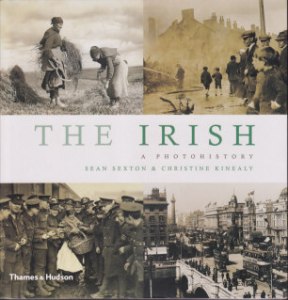
Book Review: The Irish: A Photohistory 1840-1940 by Sean Sexton and Christine Kinealy

The Irish: A Photohistory 1840-1940 by Sean Sexton and Christine Kinealy

The Irish: A Photohistory 1840-1940. By Sean Sexton and Christine Kinealy. Published by Thames & Hudson, 500 Fifth Ave., New York NY 10110. www.thamesandhudsonusa.com . 2002 Hardback $40, 2013 Softcover $21.95. 224 pp. Illustrations, index.

The introduction to the book points out that “photographs remain an undervalued and underused source by those who are interested in Ireland’s past. Too often they are treated as appendages to the written word rather than as pieces of evidence in their own right. Yet photographs provide a contemporary record which can complement and expand upon other sources, both written and oral. They can challenge or confirm our perceptions of Ireland between 1840 and 1940 by providing fuller and more nuanced information that many written records.” (p.22-23).

The 271 photographs used here are all high quality and clear, the best of the best. They all have clear extensive captions. Accompanying the photographs is clear text placing them into a descriptive historical context, which is in many ways a good summary of the major developments and changes occurring in nineteenth and early twentieth century Ireland. The book, after the introduction, is divided into four chapters: land, landlords and the big house (Anglo-Irish landowners, the Quarter Acre Clause, Congested Districts Board, Land Commission); poverty, famine and eviction (lack of famine photographic documentation, but strong eviction evidence and why, occupations); from union to partition (role or Irish in military, Home Rule Bill, Government of Ireland Act, Irish Constitution); towards a modern Ireland (effect of Union, development especially of Dublin and Belfast, rise and fall of major industries).

This book is a fascinating read on modern Irish history, and with the photographs and their captions it is easy to dip into and explore. The reader gets a much better image of what Ireland looked like during the period than could be obtained from just reading about it.

Book Review: Discover Scottish Civil Registration Records by Chris Paton.

Discover Scottish Civil Registration Records by Chris Paton

Discover Scottish Civil Registration Records. By Chris Paton. Published by Unlock the Past, P.O. Box 119, St. Agnes SA 5097, Australia.  www.unlockthepast.com.au. 2013. 52 pp. Illustrations, index. Softcover. AU$17. Available as an e-book at www.gen-ebooks.com.  AUS$7.95

If you have literally any questions about the civil registration process in Scotland, then this book will probably have the answer. The book is well researched and thorough. It has been over a decade since I wrote about this subject in detail in my own book on Scottish research and I kept thinking as I read this – did I mention that, and in most cases the answer was yes for we had in fact used the same legal guide by Bisset-Smith for the details we wanted. This book is a lot simpler to read than the legal guide and gives the details you need to understand the process.

The book is divided into two parts. The first, much larger section, addresses civil registration in Scotland, while the second part explains registration in the other parts of the British Isles. For Scotland, the book explains how the process got established in 1855 (for comparison England started in 1837); it explains the registration processes and how they changed over the years for births, marriages and deaths. You might say that most books on Scottish research provide this information and my clear response is – not at this level of detail. For example, it explains who the preferred candidates were for registering a birth, who was responsible, how long they had to do it, and what the consequences were (legal and financial) if they did not do it in time. It explains how the rules changed when the child is illegitimate, even if the parents later married. The devil can be in the details and all the answers to these questions are different from the rules and procedures in the rest of the British Isles, so you can’t come to Scotland with experience from elsewhere and apply them here for they are not same.

In the marriage section there is a clear discussion on what the difference is between a regular and irregular marriage and the effect on registration. It also explains how and why things changed with the introduction of civil marriage and same sex marriages.

For each of the birth, marriage and death sections it also addresses the minor records that are applicable to Scotland, which are much more readily accessible now, such as: foreign returns; consular returns; foreign registers; events at sea or in the air; military returns, etc.  One unusual, but helpful addition is a section on vaccination records, how to locate them, and especially what happened when parents did not follow through with the compulsory vaccination.

The book acknowledges the use of ScotlandsPeople to access the records but does not go into depth on how to do so, as there is another book by this publisher on how to us ScotlandsPeople. This book does include information on how the records might be accessed, for specific time periods, on other websites such as FamilySearch.

There is a section addressing the principals of civil registration in: England and Wales; British overseas and military records; Ireland; and Crown dependencies. This section does not go into as much depth and the author is not on as firm a ground as he is with Scottish records, omitting how many days the parents had to register a birth, and the effect this has on index searching; or how a burial can occur when a death certificate is not issued. These weaknesses in the English section do not detract from the book overall for the focus is on the Scottish records. The book is current and hot off the press for it mentions the 17 July 2013 formal royal assent of the Marriage (Same Sex) Couples Act of 2013.

This highly recommended slim guide to Scotland’s civil registration records is packed full of the details that genealogists love. It will help you understand the rules and processes by which your ancestors registered the key events in their lives.

Veterans Day – fun video

Veterans Day is an important time of the year to remember all our veterans. I could write a lot about military ancestors and will be over the next year as we move towards the 100th Anniversary of the start of World War I.

However today I want to share a fun video with an army flashmob playing Colonel Bogey in the Capitol Shopping Market in Cardiff. Enjoy.

http://www.liveleak.com/view?i=a7e_1381073342


Book Review: A Tour of the English Lakes with Thomas Gray and Joseph Farrington RA by John R. Murray

Thomas Gray - Elegy Written in a Country Churchyard
A Tour of the English Lakes with Thomas Gray & Joseph Farrington RA by John R. Murray

A Tour of the English Lakes with Thomas Gray & Joseph Farrington RA. By John R. Murray. Published by Frances Lincoln Ltd, 4 Torriano Mews, Torriano Avenue, London NW5 2RZ, England. www.franceslincoln.com. 2011. 159 pp. Illustrations. Hardcover. £25 or $45. 

Thomas Gray has almost been forgotten except perhaps for this Elegy Written in a Country Churchyard. Yet, his journal is regarded by many as the first example of modern travel writing. His journal covers a number of journeys, but in 1769 he traveled through the English Lakes, now known at the Lake District. The journey reported here is a transcription of the journal but also an account from four letters to a friend Dr. Thomas Wharton, which was needed to fill in a gap in the journey. The journey took fifteen days, and covers 17 pages of the book. It is an excellent portrayal of travel in this time period and is relatively easy to picture if you are familiar with the area. The book includes sample pages from the manuscript showing tight clear writing and detailed sketches.

     A few years later, the artist Joseph Farrington made a similar tour following in Gray’s footsteps, painting what he saw along the way. These paintings included water colors and ink-and-wash (sepia) sketches. A number of these plus engravings of these scenes were published in 1789 and 1816. For this volume those paintings relating closely to Gray’s journey have been selected to create a visual tour of the Lakes. They are arranged by locality showing different scenes around the Lakes: Ullswater (6); Derwentwater (9); Bassenthwaite (1); Thirlmere (2); Grasmere and Rydal Water (5); Windermere (6); plus some supplemental drawings. The location of each viewpoint is indicated on maps reproduced from Peter Crosthwaite’s Maps of the Lake District, originally published in 1794. For each of the localities chosen there is usually a two page spread showing the watercolor, engraving and a modern photograph from as near to the painters viewpoint as possible, plus explanatory text or a descriptive quote that accompanied the 1816 publication of the images. Many of the photographs are spot on with little changed in the scene, though a number of the photographs needed to be taken from slightly higher elevations because of modern tree growth.

     For anyone with ancestors in the Lake District who wants to get a feel for what the countryside was like before the roads developed, or the tourists arrived, or for ancestors who made the tour to the Lakes, then this beautifully illustrated book will help put them into context. The book also provides a good bibliography on the early history; the artists, writers and tourists who traveled in the area.