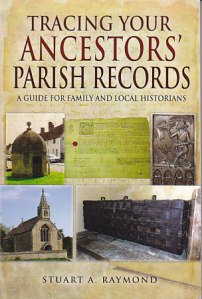
Book Review: Tracing Your Ancestors’ Parish Records by Stuart A. Raymond

Tracing Your Ancestors’ Parish Records A Guide for Family and Local Historians by Stuart Raymond

Tracing Your Ancestors’ Parish Records: A Guide for Family and Local Historians. By Stuart A. Raymond. Published by Pen & Sword Family History, 47 Church Street, Barnsley, South Yorkshire S70 2AS, UK www.pen-and-sword.co.uk. £12.99. US Distributor: CasemateIPM 908 Darby Road, Havertown PA 19083. www.casemateipm.com. $24.95. In Australia from www.gould.com.au. $30.25.  2015. 148 pp. Illustrations, index. Softcover.

This is a subject I know something about having written two recent books on English parish registers and the Parish Chest records. Yet, this book was a delight to read adding details and expanding upon what I already knew about the subject.

For many family historians it is the baptism, marriage and burials registers that are first and often only records used to identify an ancestor and put them into a specific time and place. These registers are covered in this book, but in one short chapter in the middle of the book. It is the other records created by the parish that will make our ancestors come alive. Their level in society is irrelevant as they will either be conducting the business of the parish, working for the parish in one of many capacities, or receiving assistance from the parish and its officers. In other words everyone can and should be found in these records, assuming they have survived for your parish of interest.

So what is here? The English parish was an integral part of English life for at least a thousand years, certainly up through the early twentieth century. Order within the country was maintained through the parish its officers and institutions, including: clergy; guilds; vestry; churchwardens; overseers; constables; highway surveyors; parish and vestry clerks; beadsmen; beadles; organists and singers; dog-whippers; and sidesmen all of whom are put into context and all of whom generated records and accounts. The parish itself is governed by the vestry so it is the vestry minutes and account books of the different officers that are often the most voluminous and detailed records within the parish, and unfortunately the least indexed or published. Until the mid-nineteenth century the parish was responsible for the poor and the book explains how and what shape that care took, how it changed over time, and what records were generated along the way. Care needs to be taken of the church buildings and its contents so we find: inventories of church goods; bede rolls; glebe terriers; Easter books; faculties; seating plans; magazines; sermons; registers of services and preachers. The church and its members were often involved in litigation as witnesses, petitioners, or as accused in the church courts, all leaving records. To put ancestors physically on the ground and understand their worth within the hierarchy of the parish look for the tithe records; the enclosure awards and maps; or the details on the parish charities.

Throughout the book the emphasis is on understanding the history of the records, their context and what they provide or tell a researcher. The researcher is pointed towards more in depth resources through annotated recommendations often history books that have used a specific record set to describe a specific place or time period. These histories are extremely valuable in putting ancestors and the places in which they live into a correct detailed historical context, for no parish is an island unto itself. The contents of specific document types are often extracts from published sources, only a few original documents are illustrated or extracted. The reader needs to look at both the citation endnotes and the recommended reading lists within each chapter for rarely will a source be in both lists.

I agree with the descriptive text on the cover, at least for English researchers, that this “is a book that all family and local historians should have on their shelves.” You will not be disappointed as this is a big subject and this book will start you off well.

Side note – my books Discover English Parish Registers and Buried Treasures: what’s in the English parish chest by Unlock The Past focus more on how to find, use and interpret the records,, and provide lots of practical advice. The above book adds more context and history.
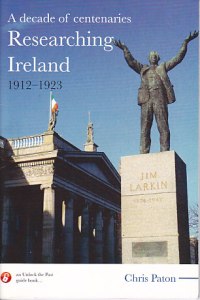
Book Review: A Decade of Centenaries – Researching Ireland 1912-1923 by Chris Paton

A Decade of Centenaries – Researching Ireland 1912-1923 by Chris Paton

A Decade of Centenaries – Researching Ireland 1912-1923. By Chris Paton. Published by UnlockThePast Publications, PO Box 119, St Agnes SA 5097, Australia. www.gould.com.au/Unlock-the-Past-guides-s/2576.htm. AUS $15.00.  Available as an e-book from http://www.gen-ebooks.com, AUS $9.95. Available in North America from www.globalgenealogy.com CAN$17.00. Available in the UK from www.myhistory.co.uk. £7.50. 2016. 52 pp. Illustrations, index. Softcover.

If there is the remotest chance that you know of, or suspect you have, 20th century family connections in Ireland this book is going to be a must buy for it is the only book dealing specifically with this complicated period from a genealogical perspective.

The book begins with an overview of the genealogical landscape, highlighting the commonly used resources for 20th century Irish research. It covers: vital records; burials; census, probate; newspapers; archives and libraries; family and local history societies; plus online record vendors all of which is information you can find in any good research guide.

It is the following chapters that are unique addressing the many different events that are being remembered in the “Decade of Centenaries” (2012 to 2023). There are separate chapters for: Home Rule, women’s suffrage, worker’s rights; the First World War; the Easter Rising; and towards independence.  In each chapter the key players, often with similar sounding names, are clearly explained in terms of what they wanted to accomplish, what they did accomplish, and on what side of the issue they were on.  So for example in the chapter on Women’s Suffrage we learn about the key leaders and the differences between the Irish Women’s Suffrage and Local Government Association (IWSLGA); Women’s Social and Political Union (WSPU); Irish Women’s Franchise League (IWFL); Irish Women’s Suffrage Society (IWSS); Irish Women’s Suffrage Foundation (IWSF). We learn about how their campaign escalates over time but comes to a close with the declaration of War in 1914, with the women being encouraged to support the war effort. The chapter continues highlighting online resources that provide context but also enables researchers to find their ancestors who were involved. Looking at the Easter Rising we learn to understand the differences between the: Irish Volunteers; Irish Citizen Army; Cumann na mBan; Fianna Éireann (Na Fianna hÉireann); Hibernian Rifles all of whom fought against the British.

Throughout the book mini-case studies and resources highlight the Irish who were on both sides of the issues either against the British or against each other. Mr. Paton does an excellent job of simplifying the complex history of Ireland in this time period and pointing you toward the records, many of which are already online or are coming online, and of course indicating where the originals are for those not yet online. This book is highly recommended for anyone with 20th Century Irish research even if you think, like the author did, that your ancestors were not involved in the troubles or movements in any way.

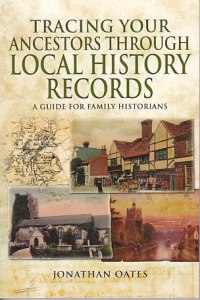
Book Review: Tracing Your Ancestors through Local History Records by Jonathan Oates

Review of Tracing Your Ancestors through Local History Records by Jonathan Oates
Tracing Your Ancestors Through Local History Records: A Guide for Family Historians by Jonathan Oates

Tracing Your Ancestors through Local History Records: A Guide for Family Historians.  By Jonathan Oates. Published by Pen & Sword Family History, 47 Church Street, Barnsley, South Yorkshire S70 2AS, UK www.pen-and-sword.co.uk. £14.99. US Distributor: CasemateIPM 908 Darby Road, Havertown PA 19083. www.casemateipm.com. $29.95. 2016. xv, 148 pp. Illustrations, index. Softcover.

This book is not for the beginner who is looking for ideas on how to trace their ancestors. Rather it is the for the individual who has already been researching their ancestors, possibly for years, and has names, dates and places, but does not know a lot about their ancestors. This book is for those wanting to flesh out their ancestors, learning more about their lives and times by exploring local history, not just family history. The book encourages and guides the individual to study the history of the locality; whether that is a county, city, town or parish. All of our ancestors were influenced by the immediate society in which they lived, worked, played, traveled and worshipped and by the friends and neighbors who surrounded and supported them. This book is designed to guide you to learning more about the lives of our ancestors and the society in which they lived.

Interestingly, the book begins in a great place with a brief overview of English history, noting especially how the relationships between the crown, government, church, society and industry were changing over time. It is a good framework on which to add your own increasing knowledge about the locality on which you choose to focus. The next four chapters focus through broad categories on some of the types of record that will be encountered: books and journals; photographs and illustrations; maps and plans; and newspapers. These records are covered in broad strokes, but it is enough to get the reader thinking about where to look and what to be looking for in their locality. The next two chapters address where to be looking for these records – local archives and libraries, plus national and regional repositories. Here a researcher will find the expected suggestions, but it the less than obvious that adds value here, such as the records of the town clerks; parish vestries; parish councils; quarter sessions; county councils; committee minutes; civil defense; school records; clubs; businesses; property records; parliament; ecclesiastical organizations; and many more.

Not all local history can be found in books, libraries or archives. The researcher is encouraged to visit the area and see the place for one’s self. However, it is better to have gotten some of the guidebooks first so that you know what you are looking for and at when one finds the things that make the place unique or the same as other places. The following two chapters highlight the value of other sources such as oral history and ephemera, plus outline what may be found in museums, local and thematic.

The book concludes with an overview of the origins and development of local history, highlighting the movers and shakers over the centuries that have shaped this fascinating field.

The book does not deal with any group or type of record in depth, but does get you thinking about what might exist for your locality and provides guidance about how and where to go looking for the records. If you want more depth on a specific aspect of local history that resource is likely to be included in the good but select bibliography. This book does a good job of thinking how and where to go next, to get beyond the names, dates and places of family history.

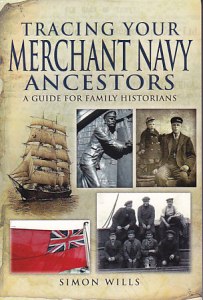
Book Review: Tracing Your Merchant Navy Ancestors: A Guide for Family Historians by Simon Wills.

Tracing Merchant Navy Ancestors A Guide for Family Historians by Simon Wills

Tracing Your Merchant Navy Ancestors: A Guide for Family Historians. By Simon Wills. Published by Pen & Sword Family History, 47 Church Street, Barnsley, South Yorkshire S70 2AS, UK www.pen-and-sword.co.uk. US Distributor: CasemateIPM 908 Darby Road, Havertown PA 19083. www.casemateipm.com. 2012. x, 180 pp. Illustrations, index. Softcover $29.95

Pen & Sword continues its excellent Family History book series with this guide to researching your Merchant Navy ancestors, a common occupation for many British ancestors, yet they can be difficult to trace. This guide book puts your ancestors into social context and provides guidance on where to find specifics on the men, and the ships on which they sailed.

The book is divided into nine chapters: Britain’s Merchant Fleet; life in the Merchant Service; finding and following a ship; tracing seamen and non-officers; captains and other officers; disaster and bravery; Merchant Navy in wartime; places to visit; case histories.

The book is full of fascinating helpful facts that put your ancestors and the research issues into context. For example, in 1899 there are 10,998 British-registered steam and sailing ships over 100 tons, dwarfing the closest rival the USA which had only 2,739 seagoing ships, while other countries went down from there. The ships are also not necessarily where you might expect them to be for in 1835 a list of the top ten ports where ships are registered includes, not surprisingly in the number one position London with 2,663 ships, Newcastle in number two with 987 ships, but how about Whitehaven, Cumbria in the number 7 slot with 496 ships, and Southampton a well- known port does not make the list.

One of the keys to Merchant Navy research is understanding where and when your ancestor was likely to have been as sea. The records, and thus where and how to search vary greatly by time period. In additional many of the record collections have been broken up and disseminated to archives scatted around the British Isles, with a large collection to the Maritime History Archive at the University of Newfoundland. Luckily the book does provide suggestions on when the records are centrally located, plus where and how to search when they are not.

The book is not just for those who served as ships masters, mates and seamen, but also includes all the other occupations you may find at sea such as carpenters, cooks, donkeymen, engineers, firemen, greasers, gunners, medical officers, pursers, stewards, storekeepers, telegraphers, and trimmers. The role of women is also highlighted.

Each chapter has numerous illustrations of ships, crew and the documents they used or those created by officials. There are numerous finding aids, and references suggested and where you may also find material online the web addresses are provided. I was actually surprised at how much may now be online, making the search process from outside the British Isles a little easier.

If you have Merchant Navy ancestors you will certainly want to have a look at this up to date research guide.


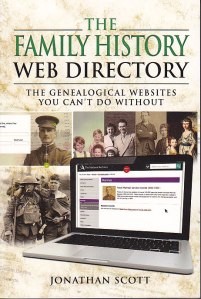
Book Review: The Family History Web Directory: The Genealogical Websites You Can’t Do Without by Jonathan Scott

The Family History Web Directory: The Genealogical Sites You Can’t Do Without by Jonathan Scott

The Family History Web Directory: The Genealogical Websites You Can’t Do Without.  By Jonathan Scott. Published by Pen & Sword Family History, 47 Church Street, Barnsley, South Yorkshire S70 2AS, UK www.pen-and-sword.co.uk. ₤14.99. US Distributor: CasemateIPM 908 Darby Road, Havertown PA 19083. www.casemateipm.com. 2015. viii, 245 pp. Illustrations, index. Softcover $24.95

Mr. Scott comes to the task as a freelance writer, former deputy editor of Family History Monthly, and writer, since 2007 of the ‘Best websites’ column for the Who Do You Think You Are? Magazine. He is therefore used to finding and evaluating genealogy websites with the depth and breadth of experience clearly showing.

The introduction to the book explains the filing system at work in the book. “Each chapter lists websites broadly in order of importance, interest and usefulness. The idea being that for those just starting their research into a particular branch or topic, this will lead them quickly to the best of most interesting resources. Then in the index at the back all the websites appear again, often more than once, but listed this time alphabetically by title, content or subject.” (p.vii)

The book is divided into five sections. The first section identifies websites for getting started in genealogy addressing the fundamentals such as civil registration, census and parish registers. The second and longest section, entitled digging deeper, takes you into all sorts of record groups: burial records and monumental inscriptions; probate and wills; taxation; election records; crime and punishment; court records; coroner’s inquest; poor law and workhouses; schools; directories; newspapers; migration; overseas research; Wales; Ireland; Scotland; hospitals and medicine; catholic records; Jewish records; nonconformist records; photographs and films; Londoners; maps; estate records; seventeenth and eighteenth century sources; slavery; sports and pastimes. The third section examines websites for military and conflict, addressing each of the services, as well as examining specific conflicts and time periods. The fourth section addresses occupations with nineteen different categories with the last being a catch all for other occupations and apprentices. You will likely find multiple sites here for your occupation of interest. The final section covers miscellaneous sites identifying: resources by region; blogs and forums; house history; medieval ancestors; heraldry; nobility and gentry; sharing research; social networking; plus software and apps.

For each entry it provides a title; address and a brief description if warranted, and often one is needed, which just adds to the value of the listing.

While I was reading this book I found myself marking those sites that I had never heard of and wanted to go and check out, or ones that I had not visited in a while and I wanted to remind myself to have a fresh look. All the time I was thinking will this provide something new for my own research? The result was a book with a surprisingly large number of marks of sites I need to check out. I am working through the marks as time allows and finding all sorts of additional information.

Most people are unlikely to read this book from cover to cover. Rather it is a tool to aid you in your research. It is one to be dipped into to solve a problem or to specifically look for new websites. In that sense it is a goldmine of leads for British research. I can highly recommend it. Yes, some of the websites will become obsolete, so you can use the wayback machine at archive.org. You will also still need your favorite search engine as new websites will be created. In the meantime, get this book.

Book Review: Discover Irish Land Records by Chris Paton

Discover Irish Land Records by Chris Paton, published by UnlockThePast

Discover Irish Land Records. By Chris Paton. Published by UnlockThePast Publications, PO Box 119, St Agnes SA 5097, Australia. www.gould.com.au/Unlock-the-Past-guides-s/2576.htm. AUS $17.00. Available as an e-book from http://www.gen-ebooks.com, AUS $9.05. Available in North America from www.globalgenealogy.com CAN$19. Available in the UK from www.myhistory.co.uk. ₤7.50. 2015. 60 pp. Illustrations, index. Softcover.

Mr. Paton succeeds very nicely in his stated purpose which is to introduce the reader to some of the basic land records available online and offline, and to outline how they may be used for genealogical research.

The book is divided into five chapters. The first gives a brief overview of the troubled history of Ireland from the Gaels, Vikings and Old English, up through the partition of Ireland in May of 1921, highlighting the impact events had on land ownership. The second chapter addresses boundaries and administrations which are a necessity to understand for different jurisdictions govern how different records are organized. You get the usual explanation of provinces, counties, baronies and civil parish, but you also get descriptions of lessor know jurisdictions such as manors, demesnes, boroughs, district electoral divisions and registrations districts. The differences between English and Irish acres (or Plantation acres) are explained here.

Starting with chapter three the book gets into the records themselves focusing on where the people were examining vital records, decennial censuses, census substitutes, directories, electoral records and newspapers. Chapter four moves into records of tenancy, ownership and valuation and this is where along with the familiar, lessor known records will be found. The chapter covers estate records, leases, rentals, quit rents and ground rents, estate maps, probate records, land registration, the Down Survey, tithe and valuation records. The final chapter encourages the researcher to discover what a place looks like and how it has changed over time by examining the Irish historic town atlas, the ordnance survey maps and memoirs, along with gazetteers, journals and parish histories.

Chris, as usual has provided the researcher with an up to date practical guide for doing Irish land research. He explains how to find the records, both for the North and South, online and offline. What stands out are the record examples, usually from his own research in the North, for they illustrate well why you should go looking for your ancestors in these records. The examples include transcripts from: eighteenth century newspaper advertisements for sale of a family property; a nineteenth century lease agreement for a small plot of land describing fees and obligations; a lease for multiple lives showing how they changed over time; rental agreements showing changes in fortune and ownership; and tithe payments that change through Griffiths and the valuation books. The suggestions and ideas in this book will keep your Irish research going for a while and will likely take you into records you have not explored before. It is highly recommended.

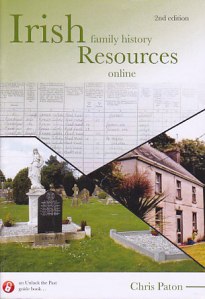
Book Review: Irish Family History Resources Online. 2nd ed. by Chris Paton

Irish Family History Resources Online, 2nd ed. by Chris Paton

Irish Family History Resources Online. 2nd ed. By Chris Paton. Published by UnlockThePast Publications, PO Box 119, St Agnes SA 5097, Australia. www.gould.com.au/Unlock-the-Past-guides-s/2576.htm. AUS $19.50. Available as an e-book from http://www.gen-ebooks.com, AUS $9.05. Available in North America from www.globalgenealogy.com CAN$21.50. Available in the UK from www.myhistory.co.uk. ₤9.00. 2015. 64 pp. Illustrations, index. Softcover.

Mr. Paton rightly points out that the Irish, north and south, have been dragging their feet when it comes to providing access to records to assist researchers in finding their ancestors. But that is all changing, and actually very rapidly as this book illustrates, with a revision of a book first published in 2011. Great strides have been made by the General Register Office in Northern Ireland and the National Archives of Ireland with their digital platforms, new websites have been created and sadly a few have disappeared.

The book is divided into five sections. The first, and largest, examines who are the Irish, specifically addressing: civil registration; the GRO Ireland indexes; church records; burial records; wills and probate; biographical databases and heraldry. The second focuses on where were they, covering: censuses; street directories; land records; maps and gazetteers. The third section examines archives and libraries: PRONI; National Archives of Ireland; National Library of Ireland; RASCAL (research and special collections available locally) and IAR (Irish archive resource). The fourth section highlights newspapers, books, journals and magazines. The final section of useful material covers: gateway sites; military, police and the law; emigration; miscellaneous sites of interest; and magazines.

There is a growing collection of Irish records coming online through the large international sites, especially FamilySearch (free); FindMyPast and Ancestry (commercial). These collections and all the major Irish sites are thoroughly discussed highlighting when it is better to use one site over another because of better, more flexible search engines, more extensive collections, or cheaper options. Often it is not clear what collections are on which site, for what time period. This book describes the collections, the periods they cover, and importantly explains how to drill down to the correct dataset. The advanced search options are explained along with how to interpret the results. A full section about a particular set of records needs to be read because another website may provide a more extensive set of results, or more details. The book is well illustrated with numerous screen shots.

The book is full of clear practical advice that will be of value to both the novice and seasoned Irish researcher because so many resources are coming online quickly. Even though this book is new (2015), major collections (e.g. Irish Catholic Parish Records) have still come online since it was published. The records that are already online and those that are coming online are changing how we do Irish research. If you are doing Irish research this guidebook will make your life easier providing guidance on accessing online Irish indexes and records through a growing variety of websites.

Book Review: A List of the Officers of the British Army to August 1755 edited and annotated by Nicholas Steward

A List of the Officers of the British Army to August 1755 (with an Appendix to October 1755). Edited and Annotated by Nicholas Steward. Published by Steward Archives, Salem, MA www.stewardarchives.com 2015. xxxi, 261 pp. Index. Softcover $17.95.

This is an edited and annotated version of the second edition, published in 1755, of A list of the General and Field Officers, as they Rank in the Army. A List of the Officers in the several Regiments of Horse, Dragoons, and Foot, &c. on the British and Irish Establishments: with the Dates of their Commissions, as they Rank in each Corps … , what became more familiarly known as the published Army Lists. Its publication by the War Office let it be formally known that these were the officially recorded officers of the army as of the date of publication, a problem with an army spread across the globe in an era with slow communications, and thus these were the people who would be paid by the War Office.

The first edition of the list was published in July 1754. The second edition, published in London, in early August 1755 is freely available for download from The National Archives digital microfilm as WO65/2. However, what is used here is the November 1755 Irish printing of the list. This is important because by then news of Major General Edward Braddock’s defeat by French forces in the wilderness of North America on the 9 July 1755 had been widely reported in the newspapers and those identified as dead are now in the published list.

There are problems with using the published Army Lists. The army was constantly changing: officers died, retired, were promoted within their own corps or exchanged to another one; new corps were raised; existing corps were transferred between the British and Irish establishments, with the consequential changes in number of officers and men. But a major problem arises in that there was no connection between editions, so if an officer left the army for any reason he would just be absent from the next list. What Mr. Steward has done is adapted an idea from the unofficial Hart’s Army Lists, (1840-1915) which included a listing of officer changes since the last publication indicating who had been promoted, resigned, or died. Thus in this annotated publication if the reason why an officer is absent from the 1756 is known then it is included in the footnotes on the same page as the officer.

The footnotes include numerous helpful identifiers for researchers. The official listing may identify officers only by title, e.g. Earl of Loudon, who is further identified in this volume as John (Campbell) 4th Earl of Loudon, which is obviously much more helpful. Looking further at the 44th Regiment of Foot as an example we see in the original published Army List the Colonel is listed as Sir Peter Halkett, but here he further identified as the 2nd Baronet. Later in the same regimental listing are Captain Francis Halkett and Lieutenant James Halkett, identified by Mr. Steward as the sons of Peter. It is also states here that Peter and James were both killed at the Battle of the Monongahela, America on 9 July 1755 (Braddock’s Defeat). There are many officers in this regiment identified as killed or wounded in this battle.

What the published Army Lists provide is details of:
• Field Officers and above in the army from the Captain-General to major with on one or more of the following rubrics: date of their rank in the army; date of their rank in the regiment or corps, their office in the garrison, or if they were on half-pay.
• The regiments, corps, and garrisons on the British Establishment listed by seniority.
• Half-pay officers on the British Establishment
• The regiments, corps, and garrisons on the Irish Establishment listed by seniority.
• Half-pay officers on the Irish Establishment
• Annual and daily pay rates, succession of regimental colonels, uniforms, and regimental locations.

What has been added to this annotated volume, as introduction and appendices are:
• An excellent introduction to the history of the development and content of the published Army Lists, plus an explanation of changes added here and why
• Corps of Engineers (Office of Ordnance) which are not listed in the Army Lists until 1757, identifying name, rank and location
• Annual Full-Pay, Half-Pay & Strength of the Land Forces
• Regiments reduced or disbanded with Half-Pay Officers
• An essay on the political state of Europe and Great Britain in 1748
• Chronology of events from 1748 (Peace of Aix-La-Chapelle) to 1756
• Braddock’s Defeat
• Other Offices held by Army and Garrison Officers.
The book provides a full index to all officers, a good glossary of period specific military terms and a bibliography. Researchers will want to read the introduction closely to understand what is and is not included, how to understand dates (calendar change) and abbreviations, plus the raising of numerous permanent Corps of Marines and where their officers came from.

Much has been written in North America about the French and Indian Wars. It needs to be remembered that this was one part of the much more global Seven Years’ War and the British Army was fighting around the globe. This annotated listing targeting North American researchers is of value to anyone doing British Army research in the period. The layout makes it easier to read, use and understand than the original published lists and is thus recommended as a research tool.

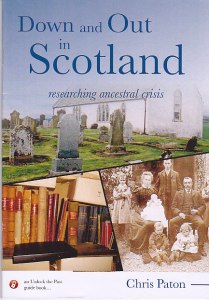
Book Review: Down and Out in Scotland researching ancestral crisis by Chris Paton

Down and Out in Scotland: Researching Ancestral Crisis by Chris Paton

Down and Out in Scotland researching ancestral crisis. By Chris Paton. Published by UnlockThePast Publications, PO Box 119, St Agnes SA 5097, Australia. . AUS $16.50. Available as an UnlockThePast e-book, AUS $7.95. Available in Canada from Global Genealogy  CAN $18.50; in the US from Maias Books $18.50 and in the UK from My History  ₤7.  2015. 56 pp. Illustrations, Index. Softcover.

Chris Paton’s experience as a diversified Scottish genealogical researcher comes through in this book about the down and out in Scotland. Many of our Scottish ancestors at one time or another fell on hard times, at which point society may have worked for them or against them depending upon the situation. In most cases someone was there to record the event and its consequences. It is the recording of these events that can break down the brick walls, or at minimum provide social context for how an ancestor was living or dying. Not every possible situation is addressed in the book, but many are and they will stimulate you to thinking about what else may survive.

In each of the six parts to the book the goal is to highlight some of the areas where records may have been generated. Part one examines family events and relationships focusing on: illegitimacy; foundlings, orphans and adoption; marriage, bigamy and divorce; homosexuality; and death. Part two looks at law and order outlining the many jurisdictions involved and where their records may be found, which includes: the Kirk; the Crown; franchise and burgh courts; criminal prosecution; murder; additional courts; police and prison records; transportation; and execution. Part three explores poverty, for which in Scotland there were distinctions between the ‘deserving poor’ and the ‘undeserving poor’, showing how they are different under the Old and New Poor laws and the records they created. Part four addresses debt, an issue for which it was easy for any of our ancestors to succumb no matter what levels of society, and this section especially seems to have its own vocabulary and sources, all worth exploring. Part five looks at medical problems, examining in particular: hospital records; asylums; suicide; and accidents. The final section entitled them and us, explores the periods in Scottish history when the aspirations of the people did not match those of the state or its many agencies, invariably generating hardship. The periods covered include: the Covenanters and the Killing Time; the Jacobite Rebellions; the expulsion of the Gael (Highland Clearances); and the struggle to vote. The book concludes with a brief bibliography and an index.

This is definitely not a book to begin your Scottish research with. It assumes you have done your basic research and you want to go further, into more depth, and explore the troubled lives of your Scottish ancestors. It will help you understand how Scottish society worked, what records were created, may have survived, and may have been indexed and how to access transcripts or the originals. There is much in this volume that I have not seen in other Scottish guide or reference books, so is highly recommended for those wanting new avenues to explore.

Chris Paton will be speaking with me on the upcoming July 2015 UnlockThePast Cruise to the Baltic seaports.

Here are links to some of Chris Paton’s other books that I have reviewed on this blog.

Book Review: Tracing Your Naval Ancestors – A Guide for Family Historians by Simon Fowler

Review of Tracing Your Naval Ancestors by Simon Fowler ISBN 978 1 84884 625 8
Tracing Your Naval Ancestors: A Guide for Family Historians by Simon Fowler

Tracing Your Naval Ancestors: A Guide for Family Historians. By Simon Fowler. Published by Pen & Sword Family History, 47 Church Street, Barnsley, South Yorkshire S70 2AS, UK. www.pen-and-sword.co.uk. ₤12.99. US Distributor: Casemate Publishing, 1016 Warrior Road, Drexel Hill, PA 19026. www.casemateathena.com. US$24.95. Australian Distributor: Gould Genealogy & History, PO Box 119, St. Agnes SA 5097. www.gould.com.au. AUS$34.95. 2011. xi, 186 pp. Illustrations, index. Softcover.

Even the author admits that researching a Royal Naval ancestor can be intimidating, especially in comparison to working with the records of the British Army or the Royal Air Force. Yet, Fowler provides a clear guide on how to use and access these records found in numerous repositories around the British Isles. The bulk of the records are found at The National Archives at Kew, and he recognizes that Tracing Your Naval Ancestors by Bruno Pappalardo will be needed to fully use this repository but it is the identification of resources in other locations, including the internet, that makes this a valuable addition for Royal Navy research.

The book begins by providing a short introduction on how to get started in your research, emphasizing which common generally utilized records may provide indications of a career in the Royal Navy. Records of officers and ratings can be located back to 1660, with a higher rate of success than is likely to be found with the land forces. The discussion for officers and ratings are different and thus separated into two chapters, yet these chapters appropriately cover the whole period up to 1914. A separate chapter addresses all levels of the service after 1914. Additional chapters address the: auxiliary services (of which there are many) and the coastguard; care of the sick and wounded; the Royal Marines; researching ships; and HM Dockyards. Appendices identify: the large number of different naval ratings, how they compare with one another as they existed in 1853; documents now held by the Fleet Air Arm Museum; how to access merchant navy records (since many Royal Navy personnel also served on these ships); jackspeak, the language of the navy; useful addresses; and bibliography.

There are many records to use for naval research, varying depending upon the time period. This book gets you into these voluminous records, explains well what they contain and is well illustrated. It is also up to date highlighting which records are online, and there are many.

This book would make a fine addition to a personal or genealogical library for anyone interested in Royal Naval ancestors, British military and any British Isles reference collection because of the sheer number of families with maritime ancestors.