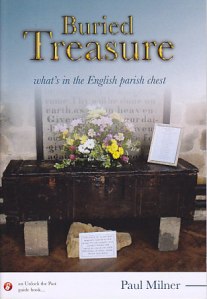
Buried Treasure – What’s in the English Parish Chest is fresh off the presses and is being released at the Rootstech / Federation of Genealogical Societies Conference this week in Salt Lake City, Utah. It is available for purchase at Maia’s Books and can also be viewed at the UnlockthePast Booth.
Buried Treasure – What’s in the English Parish Chest examines all the records created by parish officials for the civil and religious administration of the English parish, except the baptism, marriage and burials records described so well in the companion volume – Discover English parish registers.
Records surviving in the parish chest will often solve your brick wall problems, including: “Where did my ancestor come from before here?” or “Who is the father of that illegitimate child?” In this detailed guide, family historian Paul Milner explains how and why the records were created, how changing laws affected who was and was not included, what the records look like and what information they contain. After showing examples of numerous records, the guide explains how and where to access the records, (online, microfilm, originals or in print).
Here is a practical guide that will help family researchers solve their problems, and put them into historical context. This small volume is full of material for both the beginner and the experienced researcher. It is a well-illustrated guide to the contents of the English parish chest that allows any researcher to go way beyond the baptism, marriage and burial registers commonly used for parish research.
The book will be available soon in Australia from UnlockthePast, in Canada from Global Genealogy, in the US from Maia’s Books and in the UK from My History.
Tracing Your Army Ancestors: A Guide for Family Historians, Second Edition by Simon Fowler
Tracing Your Army Ancestors: A Guide for Family Historians. Second Edition. By Simon Fowler. Published by Pen & Sword Family History, 47 Church Street, Barnsley, South Yorkshire S70 2AS, UK www.pen-and-sword.co.uk. US Distributor: CasemateAthena 908 Darby Road, Havertown PA 19083. www.casemateathena.com. $24.95. Australian Distributor: Gould Genealogy & History, P.O. Box 119, St. Agnes SA 5097. www.gould.com.au. AUS$34.95. 2013. x, 192 pp. Illustrations, index. Softcover.
British Army research is a vast subject. This book breaks it down into manageable pieces. But how one does research depends upon the time period, rank, service specialty and the specific war. So the book’s chapters cover: organization of the army in the eighteenth and nineteenth centuries; the army before 1660; officers; other ranks – enlistment and conditions of service; medals; casualty rolls; discipline and desertion; pension records; militia 1757-1914; women; British in India; dominion and colonial forces; Boer War; First World War; Second World War; 1919-1969. Appendices address: army service numbers; problem solving; TNA research guides; and army ranks. Each chapter begins by providing historical and social context for the subject under discussion. This is followed by detailed guidance on the records, what they contain, how to access them and how to interpret what is found. Most subjects include bibliographies for additional reading. The chapters are well illustrated especially in terms of sample documents.
It should be noted that although there is a growing body of military records available online, it is highly unlikely that it will ever all be online. Many original records will need to be accessed in person, or through hiring another researcher, at The National Archives in Kew.
I have read and used numerous how-to-books over the last 30 years for tracing my military ancestors and can heartily recommend this one. With any good book on the subject there will be a mental interaction with the book saying “I need to try that” or “I need to check out that source”. As you do research you find more about your ancestors, and you learn more. You are in a constantly changing place, and hopefully you have tried the obvious, but maybe you haven’t because more records are coming online all the time. Reading a book such as this will give you additional clues, indexes, sources that need to be checked out making it a book worth reading again and again as you make progress. I know I marked numerous record groups, indexes and published sources that I need to examine for my growing number of army relatives.
Counting People: A DIY Manual for Local and Family Historians by John S. More
Counting People: A DIY Manual for Local and Family Historians. By John S. Moore. Published by Oxbow Books, Oxford, UK www.oxbowbooks.com. ₤17.95. US Distributor: Casemate Academic, 908 Darby Road, Havertown PA 19083. www.casemateacademic.com. $35. xii, 247 pp. Index. Softcover.
The book’s introduction states that it is written for undergraduates and postgraduate students wishing to study local populations, and for those people interested in history who want to know more about the number of people in a particular area at some time in the past, how and why that number changed over time, what jobs these people had, the structure of their society, and its constituent households and families. As family historians this includes us and this book is certainly worth reading and using.
The introduction suggests reading the last chapter first, which I did. This chapter on researching, writing and publishing gets the reader thinking about the research process, with good questions to be asked along the way to get organized and get results. It is also designed to get the reader thinking about what end result is desired – article, monograph or book, for that will help determine where to look, how and why. The questions raised here help the reader focus their reading in the other chapters to meet their specific needs.
The book is targeting English demographers, those who want to work with population numbers, but that should not stop family historians using the same sources, though some will just contain just numerical data, still helpful, most are derived from and use personal or family data, and thus contain names. The first two chapters outline the problems and questions to be addressed in researching a specific geographic area (parish, village, town, or county) and the principal methods and sources to be used in addressing these questions. The remainder of the book is divided into three periods looking at the problems and sources to be used. The first period covers the Middle Ages from 1066 through to 1525. The second period is from 1538 to 1837 when parish registers are the main source for English population history. The final section covers 1801 through the present, when the census returns provide a reliable outline of demographic developments, obviously expanded from 1837 with reports from the Registrar General.
Professor Moore assumes no expertise exists apart from a genuine interest in the subject. This means that the specifics are well explained. This might be how names or numbers are recorded in the records and how they need to be modified to get to population figures, appropriate for a demographer. For the family historian the author explains what it took to get on the list in the first place – specific age or income levels, land ownership, eligibility for military service, etc. The book provides a detailed description of what records were created, why and most importantly where to find the records and whether they may be in print or not. The latter is especially important as many of the original records will be in Latin, and on this side of the Atlantic it is easier to access print materials than to personally go look at the originals – though there are risks with that approach. Each chapter has extensive endnotes providing access to primary and secondary sources. Professor Moore practices what he describes with a case study for Frampton Cotterell in Gloucesterhire, providing estimated population figures from 1086 through 1801. This highlights the many sources that do exist for many communities within England.
The section of book that I really appreciated was the extensive (57 pages) partially annotated bibliography. This in itself is divided into seven numbered sections: 1 – Introduction to local history; 2a – handwriting, 2b – language, 2c – dating, 2d – computing and history; 3 – Anglo-Saxon England; 4 – Domesday England; 5 – Medieval England, 1135-1525; 6 – Early Modern England 1525-1750; 7 – Modern England, 1750-2011. Each of period sections is subdivided into: sources; countryside; towns; population; economic and social developments. The bibliography does not claim to be a comprehensive listing of all printed sources or studies based on these sources, but some of the sections, e.g. local assizes, manorial records, feet of fines, lay subsidy rolls, are quite extensive. I have already been through this bibliography looking for sources I want to find and have ordered through inter-library loan.
This book will expose the family historian to many resources, some of which will be familiar. I will guarantee though that you will find sources here that you have not heard of, or used. This will be especially true for those researchers who have traced back into the Colonial period and are now jumping the Atlantic and wanting to know what records are available to go back into the Early Modern or Medieval period in English research. This is certainly a book worth exploring.
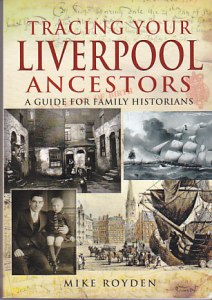
Tracing Your Liverpool Ancestors: A Guide for Family Historians by Mike Royden
The posting of this review comes as a result of a specific question following one of my recent lectures at the Dupage County Genealogical Society Conference.
Tracing Your Liverpool Ancestors: A Guide for Family Historians. By Mike Royden. Published by Pen & Sword Family History, 47 Church Street, Barnsley, South Yorkshire S70 2AS, UK. www.pen-and-sword.co.uk. ₤14.99. US Distributor: Casemate Publishing, 1016 Warrior Road, Drexel Hill, PA 19026. www.casemateathena.com. $32.95. Australia Distributor: Gould Genealogy & History, P.O. Box 119, St. Agnes SA 5097. www.gould.com.au. AUS$44.95. 2010. 260 pp. Illustrations, index. Softcover.
Royden is a well-known writer-lecturer and authority on the history of the city of Liverpool in Lancashire, England. That knowledge, experience and advice comes through clearly in this research guide. This book is so clearly focused that it is a must for anyone with Liverpool connections.
The book is divided into two sections; work and economy; society; plus appendices. The book begins by describing the development of the city, beginning with its fishing village origins. It did not begin to develop until after 1647 when it became a free and independent port no longer subject to the Port of Chester. Rapid expansion occurred in the 1660s and 1670s with the expansion of the town, development of local industries, the discovery and development of local salt deposits. Then during the eighteenth century it rose to prominence because of the transatlantic slave trade, along with its growing importance as a port and center of shipbuilding. Until around 1700 Liverpool remained one township within the parish of Walton but land enclosure and land development was changing the rural agricultural area, but the town boundaries did not start to expand until the 1830s, while the close by towns of Birkenhead and Ellesmere Port did not exist yet. The geographical isolation of Liverpool within England changed during the industrial revolution with the development of roads and turnpikes, the construction of canals and in 1830 the opening of the Liverpool to Manchester railway.
The second section focusses on society by examining: housing development; poverty; health and charity; religion and migration; education; and the experience of war. In the process of examining these subjects Royden identifies the history and records of the local institutions and organizations that impacted the lives of our ancestors. No matter at what level of society, what ethnic or religious group your ancestor belonged to he or she will have been influenced by these institutions and local organizations. This book puts everything into local context and directs your research.
What makes this volume different and even more valuable, from other regional guides in this series, is the very frequent and extensive guides to further research and reading attached to every topic discussed in the book. Inter-library loan will give the reader access to most of these resources.
The book concludes with six extensive appendices (71 pages): a research guide – pulls together information on the familiar family history records we search; a listing of archives, libraries and local study centers – providing contact information and identifying their primary holdings; web resources – identifies local history links, local photography sites, and locally focused forums and message boards; other useful organizations and resources – describing purpose, meetings, publications and contact information; museums and heritage centers – contact information and descriptions of holdings ; and recommended reading. It should be noted that even though the recommended reading list is very extensive and arranged by topic making it easy to use, it is not comprehensive and that the relevant section within the text should also be read as often additional recommendations will be made.
I’m pleased to announce that copies of my latest book – Discover English Parish Registers are now available in both print and electronic formats. It is published by Australian publisher Unlock the Past. You can purchase the e-book here for AUS$7.95 and the print copy here for AUS$17 includes GST.
Here’s how the book is described by the publisher. One note to North American readers – it’s written appropriately in the Queen’s English.
English parish records are a fundamental source for English research. In this detailed guide, family historian Paul Milner explains how and why the records were created, beginning in 1538, what the records look like and what information they contain. A well-illustrated case study, with plenty of twists and turns, shows why care is needed to trace back in time from one generation to the next. The guide continues by explaining how and where to access the records (online, microfilm, originals or in print) and concludes by explaining what to do when you can’t find your ancestors in the records.
Here is a practical guide that will help the beginner to avoid mistakes in climbing the family tree, yet the depth and details are here to assist the experienced researcher in understanding how to get the most from parish registers. This publication is a definitive guide to English parish registers that you will wish you had when you first started your research.
Wills of Our Ancestors: A Guide for Family and Local Historians by Stuart Raymond
The Wills of Our Ancestors: A Guide for Family and Local Historians. By Stuart A. Raymond. Published by Pen & Sword Family History, 47 Church Street, Barnsley, South Yorkshire S70 2AS, UK. www.pen-and-sword.co.uk. ₤12.99. US Distributor: Casemate Publishing, 1016 Warrior Road, Drexel Hill, PA 19026. www.casemateathena.com. $24.95. Australia Distributor: Gould Genealogy and History, P.O. Box 119, St. Agnes SA 5097, Australia. www.gould.com.au. AUS$34.95. 2012. xviii, 199 pp. Illustrations, index. Softcover.
Almost every book on English research highlights the need to examine the wills of our ancestors. But the devil is in understanding the details and there are lots of them. Mr. Raymond gives us an easy to read detailed guide to understanding and using the wills and associated records of our ancestors.
This book focuses primarily on English and Welsh probate records from the medieval period through to 1857, although the post 1857 wills, along with the parts of the British Isles are discussed, but in less detail. The book’s introduction discusses the value of probate records, what has survived, their origins (separate meaning of will and testament and how they got combined after 1540), probate law, along with their limitations and biases, plus a community case study. That is all in the introduction.
There are separate chapters addressing: who could make wills and why they made them; the probate process; what is likely to be found in the will (and why it needs to be treated with care); the contents, value and limitations of inventories; other probate records (litigations, act books, commissions, administration bonds, probate accounts); plus where and how to find the probate records. The book continues but with less detail on the post 1857 wills, and probate records from around the rest of the British Isles. There are a number of other groups of records outside the church and civil courts that contain probate materials and these are each addressed giving the researchers alternative sources.
There is an excellent further reading section that provides an annotated bibliography of books about the probate process, records, and guidebooks but also identifies published collections of probate records arranged by counties, and specific locations within the counties. The problem is that the listing is not complete and you might not know that unless you read everything because in the annotated section for the book by Gibson and Churchill it states – “This volume also lists numerous indexes, both published and unpublished, which are therefore not listed in the present volume” (p.109), although some of the publications in Gibson and Churchill are included here.
The appendices include: summary lists of pre-1858 probate courts, arranged by county, which can be complicated and the author makes no claim for total accuracy; guidance of where to find assistance with handwriting and Latin; a glossary of terms found in probate records; Latin glossary; and a very useful listing of legislation affecting probate.
Pen and Sword have hit another home run, with another great addition to their family history series. This book will be of value both to the beginner and the more experienced researcher.
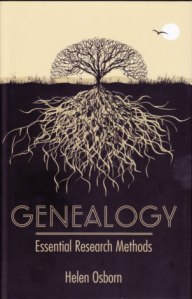
Genealogy: Essential Research Methods by Helen Osborn
Genealogy: Essential Research Methods. By Helen Osborn. Published by Robert Hale, Clerkenwell House, Clerkenwell Green, London EC1R 0HT, UK. 2012. 272 pp. Hardcover. ₤14.99
Finally, here is a research methodology book written from a British perspective. Yes, there have been a few in the distant past but this one is the first to appear in many years and it is catching up with genealogical scholarship. The book openly acknowledges that in the British Isles the emphasis is on explaining and describing the records, not how to pull everything together is one tight thoroughly researched process.
The book provides advice and inspiration on methods and problem solving skills to help the family historian understand what successful professionals do to get results and why they should be copied. The book is divided into ten chapters: (1) provides an overview of the common challenges we all encounter; (2) explores the search process and examines an effective search actually consists of; (3) and (4) look at how you can go about finding the right source and start to understand their context; (5) asks you to consider whether someone else has already solved your problem for you, and where you can look to find out; (6) shows you how to analyze a document to make sure you really are making the most of your sources once you find them; (7) looks at problem-solving using analysis and a research plan; (8) is about recording your information correctly; (9) is all about organization and presenting your results; (10) discusses the important question of how to prove family connections by using good proof standards in your research.
The book does an excellent job of getting the reader to think about what the research process is and how it can be improved and understood better to get good results.
I liked the book, it gets the reader thinking about how to improve what they do, but in some ways it lets the researcher off the hook. Let me explain. The one part of the book I found myself reacting negatively to deals with documentation and citing sources. Ms. Osborn gives three examples of the same family group sheet: undocumented; documented; and what she calls hyper-documented. The implication to the beginner by the choice of these titles is that the documented is satisfactory, when in reality it is not. The so called hyper-documented is what would be regarded as well or properly documented and would leave a good trail for researchers to follow. The text suggests the hyper-documentation is an extra step encouraged for those planning to publish, not a standard to be encouraged for all good researchers.
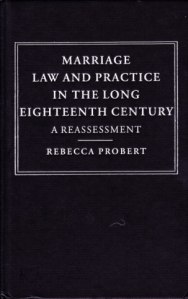
Marriage Law and Practice in the Long Eighteenth Century – A Reassessment by Rebecca Probert
Marriage Law and Practice in the Long Eighteenth Century: A Reassessment. By Rebecca Probert. Published by Cambridge University Press, The Edinburgh Building, Cambridge CB2 8RU, UK. www.cambridge.org. 2009. xii, 358 pp. Index. Hardcover. $113.
This book radically changes our understanding of English marriage law, destroying most of what has been taught by historians and genealogists regarding marriage law in the past. This book is one volume in a series entitled Cambridge Studies in English Legal History and is therefore not a light read, but is certainly worth the effort. If you want an overview of Ms. Proberts’ arguments then read her Marriage Law for Genealogists: The Definitive Guide that I reviewed earlier. If you want more details including the specifics on the case law read this volume.
Ms. Probert is a genealogist and Professor of Family Law at Warwick University, a leading authority of the history of marriage laws of England and Wales and it clearly shows here. Her arguments in this book for her case are through and backed up by legal, historical and genealogical research which makes the book fascinating to read.
A very strong case is made that the 1753 Lord Hardwicke’s Act did not constitute a radical break with the past, but rather it was a transition from canon law to English law. In many ways the new Act focused on enforcing what was already supposed to be happening and as the formal title suggests “Act for Preventing Clandestine Marriages” it was primarily aimed at one particular practice – ending Clandestine Marriages.
The book focuses on the decades before and after the Act and how the contemporary people, church and legal establishment viewed marriage. It is vitally important to use contemporary sources for it is the legal establishments in both England and America that have really muddied the waters and led many historians astray.
The book examines in detail the misunderstandings around contract per verba de praesenti, clearly defining in the process what constituted a marriage in the eyes of the church and the law. It addresses other perceived marriages practices, tracing the origins of each into the historical literature and destroying each along the way. Ms. Probert moves on to explain what a clandestine marriage is and why it was such a problem for the establishment, and for the people involved. Once defined the book looks at the passage of the Act, what the law said and what effect it had on practice. Examined are the terms of Act; contracts to be unenforceable; preliminaries to the marriage; parental control; the ceremony; registration; penalties; exemptions. It would have been a nice addition if a full copy of the Act had been included in the book.
The book concludes by examining the success of the Act, how it was interpreted afterwards by the judicial system and what the response was at the time by the non-Anglicans.
For the genealogist three sets of records are used to support her case regarding marriage practices: specific cohorts of couples drawn from baptismal registers in a variety of locations around England and Wales; settlement examinations (Bradford-on-Avon, Wiltshire); and a rare parish listing (1782 Cardington, Bedfordshire).
The book is heavily footnoted throughout citing numerous legal, historical, genealogical and social texts and studies. These provide lots of alternative viewpoints. However, this reviewer thinks the arguments have been made soundly, are strongly supported, and all genealogists should rethink what they have been taught about English marriage laws and practices in the eighteenth century. This is a good read
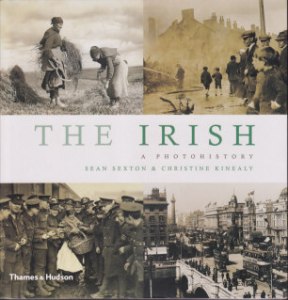
The Irish: A Photohistory 1840-1940 by Sean Sexton and Christine Kinealy
The Irish: A Photohistory 1840-1940. By Sean Sexton and Christine Kinealy. Published by Thames & Hudson, 500 Fifth Ave., New York NY 10110. www.thamesandhudsonusa.com . 2002 Hardback $40, 2013 Softcover $21.95. 224 pp. Illustrations, index.
The introduction to the book points out that “photographs remain an undervalued and underused source by those who are interested in Ireland’s past. Too often they are treated as appendages to the written word rather than as pieces of evidence in their own right. Yet photographs provide a contemporary record which can complement and expand upon other sources, both written and oral. They can challenge or confirm our perceptions of Ireland between 1840 and 1940 by providing fuller and more nuanced information that many written records.” (p.22-23).
The 271 photographs used here are all high quality and clear, the best of the best. They all have clear extensive captions. Accompanying the photographs is clear text placing them into a descriptive historical context, which is in many ways a good summary of the major developments and changes occurring in nineteenth and early twentieth century Ireland. The book, after the introduction, is divided into four chapters: land, landlords and the big house (Anglo-Irish landowners, the Quarter Acre Clause, Congested Districts Board, Land Commission); poverty, famine and eviction (lack of famine photographic documentation, but strong eviction evidence and why, occupations); from union to partition (role or Irish in military, Home Rule Bill, Government of Ireland Act, Irish Constitution); towards a modern Ireland (effect of Union, development especially of Dublin and Belfast, rise and fall of major industries).
This book is a fascinating read on modern Irish history, and with the photographs and their captions it is easy to dip into and explore. The reader gets a much better image of what Ireland looked like during the period than could be obtained from just reading about it.
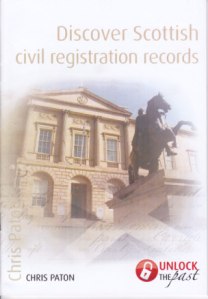
Discover Scottish Civil Registration Records by Chris Paton
Discover Scottish Civil Registration Records. By Chris Paton. Published by Unlock the Past, P.O. Box 119, St. Agnes SA 5097, Australia. www.unlockthepast.com.au. 2013. 52 pp. Illustrations, index. Softcover. AU$17. Available as an e-book at www.gen-ebooks.com. AUS$7.95
If you have literally any questions about the civil registration process in Scotland, then this book will probably have the answer. The book is well researched and thorough. It has been over a decade since I wrote about this subject in detail in my own book on Scottish research and I kept thinking as I read this – did I mention that, and in most cases the answer was yes for we had in fact used the same legal guide by Bisset-Smith for the details we wanted. This book is a lot simpler to read than the legal guide and gives the details you need to understand the process.
The book is divided into two parts. The first, much larger section, addresses civil registration in Scotland, while the second part explains registration in the other parts of the British Isles. For Scotland, the book explains how the process got established in 1855 (for comparison England started in 1837); it explains the registration processes and how they changed over the years for births, marriages and deaths. You might say that most books on Scottish research provide this information and my clear response is – not at this level of detail. For example, it explains who the preferred candidates were for registering a birth, who was responsible, how long they had to do it, and what the consequences were (legal and financial) if they did not do it in time. It explains how the rules changed when the child is illegitimate, even if the parents later married. The devil can be in the details and all the answers to these questions are different from the rules and procedures in the rest of the British Isles, so you can’t come to Scotland with experience from elsewhere and apply them here for they are not same.
In the marriage section there is a clear discussion on what the difference is between a regular and irregular marriage and the effect on registration. It also explains how and why things changed with the introduction of civil marriage and same sex marriages.
For each of the birth, marriage and death sections it also addresses the minor records that are applicable to Scotland, which are much more readily accessible now, such as: foreign returns; consular returns; foreign registers; events at sea or in the air; military returns, etc. One unusual, but helpful addition is a section on vaccination records, how to locate them, and especially what happened when parents did not follow through with the compulsory vaccination.
The book acknowledges the use of ScotlandsPeople to access the records but does not go into depth on how to do so, as there is another book by this publisher on how to us ScotlandsPeople. This book does include information on how the records might be accessed, for specific time periods, on other websites such as FamilySearch.
There is a section addressing the principals of civil registration in: England and Wales; British overseas and military records; Ireland; and Crown dependencies. This section does not go into as much depth and the author is not on as firm a ground as he is with Scottish records, omitting how many days the parents had to register a birth, and the effect this has on index searching; or how a burial can occur when a death certificate is not issued. These weaknesses in the English section do not detract from the book overall for the focus is on the Scottish records. The book is current and hot off the press for it mentions the 17 July 2013 formal royal assent of the Marriage (Same Sex) Couples Act of 2013.
This highly recommended slim guide to Scotland’s civil registration records is packed full of the details that genealogists love. It will help you understand the rules and processes by which your ancestors registered the key events in their lives.
 Buried Treasure – What’s in the English Parish Chest is fresh off the presses and is being released at the Rootstech / Federation of Genealogical Societies Conference this week in Salt Lake City, Utah. It is available for purchase at Maia’s Books and can also be viewed at the UnlockthePast Booth.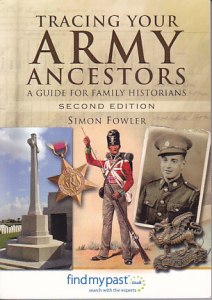

 I’m pleased to announce that copies of my latest book – Discover English Parish Registers are now available in both print and electronic formats. It is published by Australian publisher Unlock the Past. You can purchase the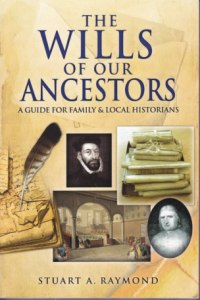
 Milner Genealogy