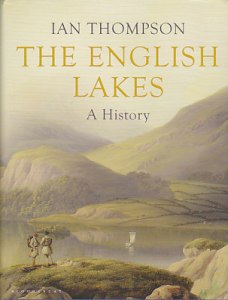
Book Review: A Tour of the English Lakes with Thomas Gray and Joseph Farrington RA by John R. Murray

Thomas Gray - Elegy Written in a Country Churchyard
A Tour of the English Lakes with Thomas Gray & Joseph Farrington RA by John R. Murray

A Tour of the English Lakes with Thomas Gray & Joseph Farrington RA. By John R. Murray. Published by Frances Lincoln Ltd, 4 Torriano Mews, Torriano Avenue, London NW5 2RZ, England. www.franceslincoln.com. 2011. 159 pp. Illustrations. Hardcover. £25 or $45. 

Thomas Gray has almost been forgotten except perhaps for this Elegy Written in a Country Churchyard. Yet, his journal is regarded by many as the first example of modern travel writing. His journal covers a number of journeys, but in 1769 he traveled through the English Lakes, now known at the Lake District. The journey reported here is a transcription of the journal but also an account from four letters to a friend Dr. Thomas Wharton, which was needed to fill in a gap in the journey. The journey took fifteen days, and covers 17 pages of the book. It is an excellent portrayal of travel in this time period and is relatively easy to picture if you are familiar with the area. The book includes sample pages from the manuscript showing tight clear writing and detailed sketches.

     A few years later, the artist Joseph Farrington made a similar tour following in Gray’s footsteps, painting what he saw along the way. These paintings included water colors and ink-and-wash (sepia) sketches. A number of these plus engravings of these scenes were published in 1789 and 1816. For this volume those paintings relating closely to Gray’s journey have been selected to create a visual tour of the Lakes. They are arranged by locality showing different scenes around the Lakes: Ullswater (6); Derwentwater (9); Bassenthwaite (1); Thirlmere (2); Grasmere and Rydal Water (5); Windermere (6); plus some supplemental drawings. The location of each viewpoint is indicated on maps reproduced from Peter Crosthwaite’s Maps of the Lake District, originally published in 1794. For each of the localities chosen there is usually a two page spread showing the watercolor, engraving and a modern photograph from as near to the painters viewpoint as possible, plus explanatory text or a descriptive quote that accompanied the 1816 publication of the images. Many of the photographs are spot on with little changed in the scene, though a number of the photographs needed to be taken from slightly higher elevations because of modern tree growth.

     For anyone with ancestors in the Lake District who wants to get a feel for what the countryside was like before the roads developed, or the tourists arrived, or for ancestors who made the tour to the Lakes, then this beautifully illustrated book will help put them into context. The book also provides a good bibliography on the early history; the artists, writers and tourists who traveled in the area.
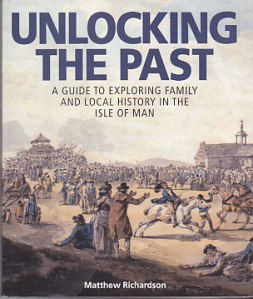
Book Review: Unlocking the Past: A Guide to Exploring Family and Local History in the Isle of Man by Matthew Richardson.

Unlocking the Past – A Guide to Exploring Family and Local History in the Isle of Man by Matthew Richardson

This review got posted as a result of meeting two special ladies in Cumbria looking for research resources for the Isle of Man. I hope this helps.

Unlocking the Past: A Guide to Exploring Family and Local History in the Isle of Man. By Matthew Richardson. Published by Manx National Heritage, Kingswood Grove, Douglas, Isle of Man 1M1 3LY, British Isles. www.gov.im/mnh/. 2011. 210 pp. Illustrations, index. Softcover. £12.

Geographically the Isle of Man is part of the British Isles. It is a Crown Dependency owing its allegiance to the British Crown with Her Majesty Queen Elizabeth II holding the title Lord of Mann. But the island has never been part of the United Kingdom. What this all means for the genealogist is that things are done differently there. Yes, there are a lot of similar records, but beginning and ending dates, access procedures, contents and relative importance are often different than we are used to finding in England.

The book opens with a historical overview of the Isle of Man, from the early native Celtic population to the present time, which will be especially valuable for outsiders, like most North American readers. The second part is a detailed guide to the main Isle of Man repositories, providing names, addresses, contact information and a summary of what is likely to be found there. The bulk of the book is a guide to areas of research, arranged alphabetically, and being one to eleven pages in length.  The topics include: Castle Rushen (prison) papers; cemeteries; census; church court records; court records; customs records; directories; emigration records; folk life survey; friendly societies; internment records; land and property records (two large important geographically separated collections); mapping; military and naval records; mining records; rolls office records; shipping company and shipping records; and more for a total of 53 different topics. For each topic you get a detailed description of the records, how and why they were created, where they are now and how to access them, and where they fit in context. Many of the topics are illustrated and contain examples of the types of information found in them.

The book concludes with five case studies tracing the context and ancestors of a: miner; soldier; broadcaster; housekeeper; and blacksmith. These case studies show how different records can be pulled together to create a good family picture, and they are well worth reading.

The book is lavishly illustrated throughout, provides a bibliography and is indexed. This book is current, tells what is coming, and is a good replacement to The Manx Family Tree by Janet Narisimham, originally published in 1986, with the 3rd ed. in 2000.

Anyone searching for ancestors or investigating the history of the Isle of Man will find this book beneficial.

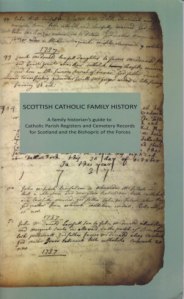
Book Review: Scottish Catholic Family History by Andrew R. Nicholl

ScotlandsPeople Catholic research
Scottish Catholic Family History: A family historian’s guide to Catholic Parish Registers and Cemetery Records for Scotland and the Bishopric of the Forces by Andrew R. Nicholl

This post came as a result of questions in a lecture I gave this morning on Effective use of ScotlandsPeople Website at the Federation of Genealogical Societies Annual Conference in Ft. Wayne Indiana.

Scottish Catholic Family History: A Family Historian’s Guide to Catholic Parish Registers and Cemetery Records for Scotland and the Bishopric of the Forces. By Andrew R. Nicholl. Published by The Aquhorties Press, Columba House, 16 Drummond Place, Edinburgh EH3 6PL, UK. www.scottishcatholicarchives.org.uk. 2011. 115 pp. Illustrations. Softcover.  £10.

The Catholic Parish Registers Project began with a focused plan – to digitize and index all pre-1855 Catholic parish registers that existed. Digitization continued beyond this date because volumes continued beyond 1855, post-1855 registers had been deposited at the Scottish Catholic Archives; plus the records of the Bishopric of the Forces, Dalbeth Cemetery in Glasgow and Mount Vernon Cemetery in Edinburgh were fully available. If the records survive in the Scottish Catholic Archives they have been digitized, though there may be more modern records still in the Catholic parishes around Scotland. The latter have not been sought after to be added to the collection at this stage. This collection is much more extensive that the photocopy collection of Catholic registers that exists at the National Records Scotland (former National Archives of Scotalnd).

In the collection there are the usual parish registers of births/baptisms, marriages and deaths/burials/funerals, each with 100, 75 and 50 years closure periods respectively to protect privacy. Other items in the collection, all with a 100 year closure, include: confirmations; confessions; converts; communicants; status animarum (“state of souls” – often a list); seat rents; and sick call. The book begins by describing all the different record classes, itemizing what they are likely to contain and showing an example.

The largest section of the book is the detailed lists of the records.  The lists are arranged by location of the parish and the saint to which it is dedicated. For each location it identifies the type of register, dates covered and the collection reference at the Scottish Catholic Archives. There is the Missions and Parishes Collection, plus the Individual Missions Collection and the researcher needs to check both lists for complete coverage of any given locality.  For the three major Catholic cemeteries in Glasgow and Edinburgh that are included there are internment registers, owners’ registers and lair registers, all of which can provide different information. The Bishopric of the Forces records are the Catholic records from the British military all over the world, unfortunately many of these still fall under the time closure rules.

The last section in the book is a directory, with maps, of Catholic parishes in Scotland. The directory in table format provides: name of the town and dedication of the church; the unitary authority; diocese; date the mission was founded; date of the church building. For most researchers, unfamiliar with Scottish geography, it is the maps locating the churches that will help us identify the parish records worth investigating for our ancestors. One additional aid included is a comprehensive Latin-England forename glossary with all case endings making it easy to distinguish the Latin variants for Patrick and Patricia or Terence and Teresa or other similar male and female names.

If you have searched ScotlandsPeople and found your Catholic ancestors you are fortunate. The bigger problem is if you have searched and not found them – is it because they are not there, the records have not survived, or you are just looking under the wrong name. It is this book that will help you identify the time or record gaps in any specific parish. This book is therefore very important for anyone working on Scottish Catholic ancestry.

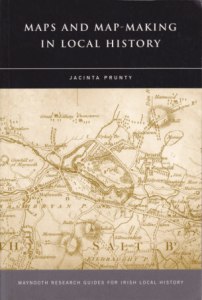
Book Review: Maps and Map-Making in Local History

Maps and Map-Making in Local History by Jacinta Prunty

I am in the process of updating a lecture on Irish Maps to be given at the 2013 Federation of Genealogical Societies Conference in Ft. Wayne, Indiana. This process reminded me of what is probably my favorite book about maps and I thought readers may also want to know about it.

Maps and Map-Making in Local History. Maynooth Research Guides for Irish Local History. By Jacinta Prunty. Published by Four Courts Press, 7 Malpas Street, Dublin 8, Eire. US Distributor: ISBS, 920 N.E. 58th Avenue, Suite 300, Portland OR 97213. www.isbs.com. 2004. 344 pp. Illustrations, index, maps. Softcover. $30

This book opens with the quote: “Maps are graphic representations that facilitate a spatial understanding of things, concepts, conditions, processes or events in the human world” (p.15). The rest of the book expands upon that theme, successfully introducing the reader to the use of maps in research, writing and presenting local history. The illustrations are all from Ireland, so it is especially valuable for those researching in Ireland, but the concepts and ideas introduced are applicable for anyone working with maps. In fact two of the appendices are worth the price of the book alone, simply because they do apply to any location —  “Questions to be asked of maps” and “Questions to ask of your place in the search for maps”.

This is essentially a practical guide, including notes on the map series that are immediately useful for local history, and thus family history in Ireland, plus information on the major repositories, catalogs and finding aids, ways to use the maps in research, and the ways the maps themselves were made. Maps provide the context in which family historians place families within a community. In local history, researchers examine how that community operated in relationship to its neighbors, what resources were shared, how the interactions and development was affected by the landscape, all of which can be seen with maps.

The book is divided into four sections. The first, and largest, provides a historical overview of map-making in Ireland. The watershed here is the six-inch to one mile Ordnance Survey maps. Their production, content and legal standing are described in detail. The maps created before and after this significant series are also thoroughly described. This section is well illustrated and provides researchers with a glimpse of what is available. The author suggests, in the process, that the researcher should obtain any and all maps for the relevant geographic area, regardless of the time period or the maps focus (e.g. railways, canals, roads, military, plantation, geology, antiquities, estates, or bogs).

A very practical chapter on map-reading skills discusses scales, projections, orientations, national grid, grid references, sheet numbering, height, contours, boundaries, measurements, dates, and symbols. Ms. Punty explains where to locate maps, how to get started, and how to use guides to local and major archives or library collections, some of which are online. The book concludes with some case studies on how maps can be used by historians, local and family. This last section of the book also addresses the issues of copyright ownership, and provides guidelines for making your own maps, with or without computers. Many references to published and online materials provide further guidance throughout the text for researchers wanting to explore Irish maps and map-making further.

There is no doubt that this will become the standard guide for anyone working with Irish maps. It is highly recommended for personal and society collections.

Book Review: The Scots – A Photohistory

The ScotsThe Scots: A Photohistory. By Murray MacKinnon and Richard Oram. Published by Thames & Hudson, 500 Fifth Ave., New York NY 10110. http://www.thamesandhudsonusa.com . 2003 hbk, 2012 sbk. 224 pp. Illustrations, index. Hbk $40,  Sbk $21.95
If you have ancestors living in Scotland after the invention of photography in 1839 you will like this book. The introduction to the book creates the big picture highlighting the major events in Scotland during the nineteenth century: repression, clearance and revival in Gaelic speaking areas; highland life and the 1886 Crofters Act; the rise and decline of industrialization and urbanization in the Lowlands; issues within the church with schism and revival to irrelevance; shifting politics from conservatism, to liberal and radical.

The following chapters portray: people; places, coastal and rural life; work and industry; transport; sport and leisure. The majority of the images are sepia-toned albumin prints, but most 19th century types of images are included. The images selected are the best of the best in terms of clarity, composition and quality.

It was for the abundant excellent images and good captions that I purchased this book. The surprise was the quality and clarity of the accompanying text. The authors do an excellent job of describing how and in what ways life was changing in Scotland. The authors show the interconnectedness between events and the ripple effects of changes in society. One example is the 1843 Disruption of the Church of Scotland destroying the seamless join between Church and State; resulting by 1845 in new parochial boards being created to administer poor relief and by1861 the Church losing its legal powers over schools.

This book is a pleasure to read and to look at. It is highly recommended if you have Scottish ancestry from the 1830s up through the end of WWI.

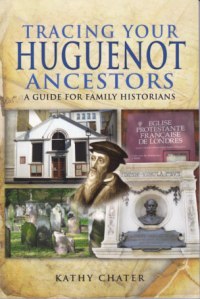
Book Review: Tracing Your Huguenot Ancestors: A Guide for Family Historians by Kathy Chater

Tracing Your Huguenot Ancestors: A Guide for Family Historians by Kathy Chater

I gave four lectures last weekend in Rochester, New York and got a number of questions about tracing Huguenots in England and Ireland, thus I thought appropriate to share this review.

Tracing Your Huguenot Ancestors: A Guide for Family Historians. By Kathy Chater. Published by Pen & Sword Family History, 47 Church Street, Barnsley, South Yorkshire S70 2AS, UK. www.pen-and-sword.co.uk. £12.99. US Distributor: Casemate Publishing, 1016 Warrior Road, Drexel Hill, PA 19026. www.casemateathena.com. US$24.95. Australia sales from Gould Genealogy and History. www.gould.com.au. AUS$29.95. 2012. 152 pp. Illustrations, index. Softcover.

Between the sixteenth and eighteenth centuries many thousands of Protestants fled religious persecution in France and the Low Countries (modern day Belgium, Netherlands and Luxemburg). They settled in the German Protestant States and the British Isles, some permanently while others later migrated to North America, the West Indies, South Africa and Australia. The book opens with a very good summary of the wars and religious conflict that led to these migrations, reminding us just how important religion was in the lives of our ancestors.

The book focusses on the communities within Great Britain and Ireland. It clearly identifies and summarizes the history, development and decline, of the specific Huguenot and Walloon communities in London, Kent, East Anglia, the West Country, Ireland, Scotland and the Channel Islands. Ms. Chater continues by suggesting a research plan with issues to consider. This is not necessarily easy for the wealthy tended to choose to assimilate joining the Church of England, seeking business and education opportunities, while the poor needed the support of their own community. The Huguenot communities could easily be connected with the Church of England or the Dissenting Churches (Congregationalists, Baptists, English Presbyterians) and often with specific occupations so a broad research perspective is required. A nice research checklist is provided of both specific and general sources, with chapters for each. The chapter on specific resources is very valuable addressing: denizations and naturalisations; returns of strangers; Huguenot church records, going beyond the church registers; poor relief and charity records; schools; charity apprenticeships; friendly societies; wills; other foreign churches. What is nice is that these records are not usually high on the priority list for researchers and so their importance and specificity for this community is valuable. The chapter on general sources points to more commonly used records, but again highlights what to look for that might clearly identify people from this community.

The closing chapters address how to research Huguenot communities with individual European countries, and the rest of the world, including briefly North America. The bibliography includes a complete listing of all titles in the Huguenot Society Quarto Series and New Series, plus how the titles have been combined and reissued on CD-ROM, along with a select bibliography.  Compared with other volumes in this series the bibliography and guidance for further research is one of the weaknesses in this otherwise up to date research guide. For example, though the chapter on the religious wars and Edicts in Europe that created this migration is well summarized there is no guidance in the chapter or the bibliography for researchers who want to know more. It should also be pointed out that when discussing the European Huguenot churches mention is made when the records have been microfilmed by the Family History Library, while no mention is made of which British Huguenot church records have been filmed.

This is a useful, up to date, practical guide for anyone who has, or thinks they have, Huguenot ancestors in the British Isles. It provides social and contextual assistance along with guidance on what records have survived, where to find them and how to use them.

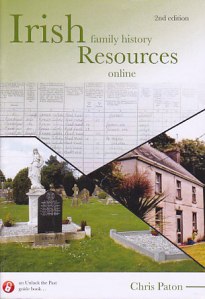
Book Review: Irish Family History Resources Online by Chris Paton

Irish Family History Resources Online, 2nd ed. by Chris Paton

Irish Family History Resources Online. By Chris Paton. Published by Unlock the Past, P.O. Box 675, Modbury, SA 5092, Australia. www.unlockthepast.com.au. 2011. 75 pp. Illustrations, index. Softcover. AUS$19.50.

Online access to indexes and images is growing rapidly for Irish research, often with the same sets of records being available in multiple locations. This book is an expanded adaption of a lecture Mr. Paton gives, it shows and I loved the format and writing style.

The book begins by discussing records to identify who the Irish were, specifically: civil registration; church records; burial records; wills and probate; biographical databases and heraldry. It moves on to examine where the Irish were: censuses; street directories; land records; maps and gazetteers. Further sections address the major archives and libraries, newspapers and books, and a final catchall section covering: gateway sites; military, police and law; emigration; and some miscellaneous sites. The book is not a listing of websites.

So what makes this book different and so useful? Unlike many Irish research books that describe what the records are and contain, this book clearly presents how to search and use the records. For example, in the section on Civil Registration the book clearly shows how to access the indexes using FamilySearch and Ancestry, what different information each provides. It continues by showing how to use the information provided to obtain a certificate or photocopy of the registered birth, marriage or death event through different avenues, with clear suggestions on cheaper alternatives. For the section on Church Records the book online identifies resource guides, commercial and free websites, often outlining their specific strengths, contents, limitations, costs and search techniques.

Throughout the book there are numerous clear color screen captures of numerous websites giving it a lot of visual appeal. All web addresses are in bold so they stand out in the text making them easy to locate and retype into your own browser. The book is also well indexed by subject and location.

This is a book that I intend to keep close and handy to my computer. It is a very practical guide to Irish online research with lots of good practical suggestions.

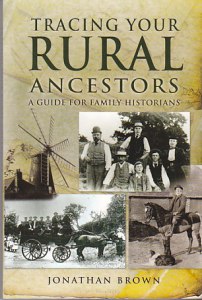
Book Review: Tracing Your Rural Ancestors: A Guide for Family Historians by Jonathan Brown

Tracing Your Rural Ancestors: A Guide for Family Historians by Jonathan Brown

Tracing Your Rural Ancestors: A Guide for Family Historians. By Jonathan Brown. Published by Pen & Sword Family History www.pen-and-sword.co.uk £12.99. US Distributor: Casemate Publishing www.casemateathena.com $24.95. Australia Distributor: Gould Genealogy, www.gould.com.au AUS$32.95 incl GST. 2011. 162 pp. Illustrations, index. Softcover.

Half the population of England and Wales lived in the country in 1851 so it is going to be relatively easy to find rural ancestors on the family tree. At the same time this is a big subject with lots of options for the researcher.

Mr. Brown begins by describing the largest group of rural workers, the farm laborer (1.4 million in the1851 census), looking at what they did, who specialized and who did not, and how their role changed with time. He continues examining who were the farmers, which are not easily defined or identified, and their relationships to the workers, along with a look at the landowners, their great houses and estates. Village life was affected by the different businesses, tradesmen and professionals who lived and worked in any given community, but all left different records to be searched. Another chapter looks at rural migrants and the rural poor. In each of these chapters suggestions are made as to what records will assist in the identifying your rural ancestors.

The largest chapter consists of an alphabetical list of records and source for rural research. This annotated list identifies all the major records you would expect, but also highlights others you may not have heard of or thought of before, such as: copyhold records; enclosure records; farmers’ unions; inquisitions post mortem; rate books; terriers and more. The listing is followed by suggestions on how to identify where the records are located and how to access them, in archives, libraries and online.

One word of caution is that the bibliography states that it “lists all books mentioned in the text together with other suggestions for further reading” (p.145) but this is incorrect for numerous books were recommended within the text that were not included in the bibliography.

Rural ancestry is a large, many faceted topic. This book is a good introduction to the subject socially and genealogically, pointing the reader in the direction of where to find the records and more advanced readings.

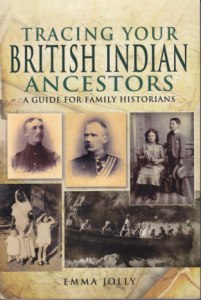
Book Review: Tracing Your British Indian Ancestors: A Guide for Family Historians

Yesterday I gave 4 lectures at the Western Australia State Library in Perth, WA. I had a number of questions about British families that came to Australia after spending time in India. I thought this book would be of interest to readers.

Tracing Your British Indian Ancestors: A Guide for Family Historians. By Emma Jolly. Published by Pen & Sword Family History, 47 Church Street, Barnsley, South Yorkshire S70 2AS, UK. www.pen-and-sword.co.uk. £14.99. US Distributor: Casemate Publishing, 1016 Warrior Road, Drexel Hill, PA 19026. www.casemateathena.com. 2012. xviii, 184 pp. Illustrations, index. Softcover. $24.95

Terms and geography need to be defined for best use of this important book. “British Indian” here refers to British citizens and Europeans who worked for the East Indian Company (generally as officers in the army), plus Anglo-Indians of mixed descent from the union of white British or European males and Indian women. Those of mixed descent were often segregated and discriminated against, yet they made an essential contribution to British India and are found in most British India records. Geographically, the area covered by this book, includes modern-day India, Pakistan, Bangladesh and Burma (modern Myanmar). Other areas that may be encountered in India-related records are St. Helena, Iraq, Iran (formerly Persia), Aden, Kuwait, Sri Lanka (formerly Ceylon), Singapore, Malacca, Penang Prince of Wales Island, Java, Sumatra (Bencoolen / Fort Marlborough) and China (Macao and Whampoa). In reality this means most places east of the Cape of Good Hope that had British connections.

The book covers the time period of 1600, when the East India Company received its Royal Charter from Queen Elizabeth I, to the present.  It begins with a chapter on how to get started, which is actually a must read, especially for North American researchers, because even though the majority of the records needed will be in England, they are not in the places even most English researchers would expect to look. The largest collection of original material is the India Office Records at the British Library, with other collections at The National Archives, National Army Museum, National Maritime Museum, School of Oriental and African Studies, or the Society of Genealogists, all in London, with a few other collections scattered around the British Isles and India. The most important society is FIBIS, Families in British India Society, which provides lots of indexes, resources and an excellent wiki.

The following three chapters present the increasing role of the East India Company from 1600 through the Indian Mutiny in 1857, its subsequent loss of control to the British government and the period of the British Raj from 1857 through independence in 1947. The focus is on historical context, but the voluminous record collections applicable to the period and their location are highlighted.

The next five chapters focus on five aspects of the Indian life where the British were heavily involved, and which created most of the records of the British Indians. These are: the servicemen and women of the East India Company’s Armies, the Indian Army, the British Army in India and the Royal Indian Air Force; merchants and ships; religion, cemeteries and schools; railways; probate records. Key throughout these chapters is the clear defining of what records and indexes to examine, and where. They identify which resources are available online, which are published and available for purchase, and what will need to be examined in person or onsite. Each of the groups of people and their records is also placed into historical context.  A closing chapter addresses Indian independence and life after 1947. Throughout the book there are a number of short case studies showcasing the biographical information and lives that can be reconstructed from the records of our British Indian ancestors.

India developed from a company outpost into the crown in the British Empire with many individuals over the centuries from the British Isles serving in its government, its military or developing its industry. Many have ancestors who moved there temporarily or permanently.  This well written research guide is a must for anyone seeking to explore their British Indian connections.

Genealogy at a Glance: English Research (or Irish or Scottish) – How to purchase in Australia and New Zealand

Genealogy at a Glance - English Research by Paul Milner
Genealogy at a Glance – English Research by Paul Milner

I have exciting news for Australian and New Zealand researchers. As I lecture in Australia there is strong interest in Genealogy at a Glance series of laminated help sheets published by Genealogical Publishing Company. I wrote the English Research guide and have a few remaining copies but expect to sell out of them at my next venue in Perth on Saturday. Brian Mitchell wrote the guide for Ireland, and David Dobson wrote the guide for Scotland, all copies sold out.
Here is how to purchase them directly from the publisher at a much reduced price from the one listed on the company’s website.   These are 1st class international postage paid prices, especially for my blog readers:
1 Genealogy at a Glance        $20
2 Genealogy at a Glance        $35
3 Genealogy at a Glance        $50
You can order via email to ecollins@genealogical.com
You can mail an order to: Genealogical.com, 3600 Clipper Mill Road, Ste 260, Baltimore, MD 21211, USA
You will need to provide either a check in US currency or credit card information.
I apologize to the participants in Brisbane who wanted to purchase additional Genealogy at a Glance laminated folders and I hope you will be happy with this arrangement that I managed to make with the publisher.