WWI – Finding the Dead – Commonwealth War Grave Commission part 3

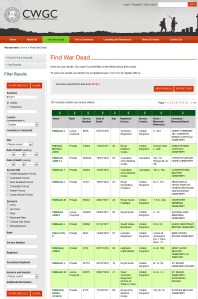
Option to filter a search on the Commonwealth War Graves Commission website

In the last post we started to discuss the search options for the advanced search screen of the Commonwealth War Graves Commission website at www.cwgc.org.  We discussed ways to search  on Surname and Forename, so please do have a look at the last post. Let us take a closer look at some of the other search options and what they mean for your searches, and why you may want to use them.

Country – use this if you know where your ancestor is commemorated. France is not a good choice as there is hundreds of thousands who died there. But if you know that your ancestor died and is commemorated in Argentina, then you are in luck as there is only two options.

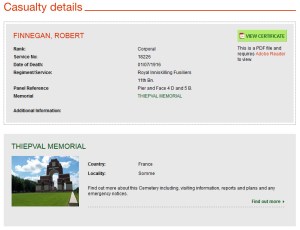
Cemetery or memorial – this is useful if you want to get a sense of context, or possibly see who else might be remembered in that location. If you start to type a place and there are multiple options a list will appear. For example, searching on Thiepval brings up four options, selecting Thiepval Memorial and searching on that location shows that 72,338 individuals are memorialized on this one memorial. These are the people for whom no identifiable remains were located to be buried. Corporal Robert Finnegan discussed in the last post is one soldier named on Pier 4D, face 5B.

War – this limits your choice to the First or Second World War

Date of Death – starting and ending – allows you to define a period in which your ancestor died, or to determine how many others died on a given day, possibly indicating if he died in a major battle or in a quiet time. For example, a search for the names of those who died on the 1 July 1916 names 18,708 individuals and obviously does not include those who died from their wounds over the following days. This was the worst day in British military history if you did not already know that.

Served with – lists the forces of the United Kingdom, Australia, New Zealand, Canada, India and South Africa. Be very cautious here as people from the United Kingdom may have served in any of the colonial forces, and many from the colonies did serve in the United Kingdom forces.

Served in – identifies the branch of service – army, air force, navy, merchant navy, civilian war dead and miscellaneous. The last category may need some clarification for this includes: munition workers, Red Cross members, Voluntary Aid Detachments, canteen workers, army cadets, ambulance drivers, war correspondents, etc.

Rank – as you start to type in this field a list of options appears from which to choose.
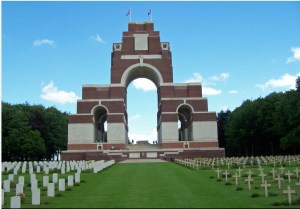
Thiepval Memorial with over 72,000 names from WWI

Service number – this search may be useful if you have this number from another source, such as a medal roll and want to identify where he is buried or memorialized.

Regiment – can be used to narrow a search, or used with dates to put a death into context. Again when you start to type a list of options appears. For example, searching on the Royal Inniskilling Fusiliers for the 1 July 1916 shows that there were 833 deaths in this one regiment alone on this day.

Secondary Regiment – should be used with caution as the majority of records contain nothing in this field.

Awards – this enables you to identify those individuals who were awarded a medal (such as the Victoria Cross), or were Mentioned in Dispatches. Returning to the 1 July 1916, with the Royal Inniskilling Fusiliers, and identifying Victoria Cross recipients we identify Eric Norman Frankland Bell of the 9th Battalion. The descriptive citation is provided, adding more color to the day Robert Finnegan died, for the 9th Battalion preceded the 11th Battalion out of the trenches moving towards the German lines.

Additional Information – can be any term but it would need to appear in the additional information part of the database. It might, for example, be used to identify others from your ancestor’s village or street.

There is a lot of material in this database and some experimenting with the search options will narrow your options to find your ancestor, at the same time additional information can be gleaned to put your ancestor into context.
WWI – Finding the Dead – Commonwealth War Graves Commission part 2

Finigan, Finnigan, Finegan, Finnegan
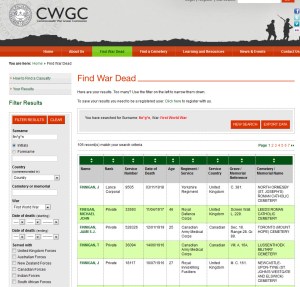
Commonwealth War Graves Commission website search for Fin*g*n

In my last posting I did a simple search to find my dead soldier – John Croudace. In this blog posting we are still working with the Commonwealth War Graves Commission website at www.cwgc.org website but let’s examine the advanced search options a little more closely. To find the advanced search you can either choose it from the simple search box on the home page, or you can select “Find War Dead” from the tab bar. Either way you end up at the same advanced search box. Note that you only need one entry in any one box to do a search.

Let’s start with the first and second boxes for surname and forenames as these are the most commonly used. You can type in any surname and search. The default for the forename is initials and I on the first pass leave the space below blank. Only if I get too many options do I insert an initial. Inserting an initial will pick up the entries in the database that use only an initial as well as those forenames beginning with that initial.

With surname it gives you exactly what you ask for, there is no sounds like or Soundex option. However wild cards are allowed. So let’s look at an example and see what difference it makes. I want to search for the name Finnigan, but did the army spell it this way, or with one “n”, or did they substitute an “e” for the “i” in the middle. If searches are made on these variations, limiting it to WWI we get the following results:

Finigan 2
Finegan 9
Finnigan 63
Finnegan 27

John Finnigan Royal Inniskilling Fusiliers
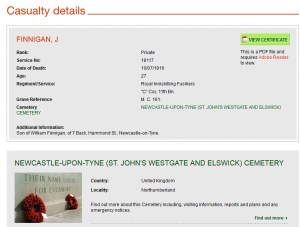
Details for J Finnigan, son of William Finnigan of 7 Back Hammond Street, Newcastle-Upon- Tyne

This gives me a total of 101 options. However, I prefer to get all my results at once. So searching on “fin*g*n” picks up all these and a few more for a total of 105. The additions are the names – Fingleton and Finighan. The results are presented in batches of 15 names.

With these numbers of results I tend to scan all to see if any are a likely possibilities, for remember you are also looking to trace the cousins, as almost every family in the United Kingdom was impacted by the war. In this search one entry jumped out at me on the first page – Finnigan, J – buried in Newcastle-Upon-Tyne (St. John’s Westgate and Elswick) Cemetery. Looking at the details in the illustration he died 10 July 1916 and most importantly he is described as the son of William Finnigan, of 7 Back Hammond Street, Newcastle-Upon-Tyne. A supposition, later confirmed, was that John Finnigan was wounded on the 1 July 1916, the first day of the Battle of the Somme, and that he was wounded severely enough to be evacuated back to England. He actually died on the transport ship returning to England, and was buried in his home town.

Details for Corporal Robert Finnegan, Royal Inniskilling Fusiliers on Thiepval Monument

John was a private in “C” company, 11th Battalion of the Royal Inniskilling Fusiliers. Interestingly John has a brother Robert, and when the rest of the list is examined there is a Robert Finnegan, who is a Corporal in the 11th Battalion of the Royal Inniskilling Fusiliers, killed on the 1 July 1916, the first day of the Battle of the Somme. In this case though there is no data entered in the additional information section. From this source alone I cannot confirm if this Robert is or is not the brother of John.  He is, but other sources are needed to confirm that.

In the next blog posting I will discuss some of the other search options, why and when you might want to use them.

WWI – Finding the Dead – Commonwealth War Graves Commission part 1

Home Page fro Commonwealth War Grave Commission Website with simple search box in upper right.
Home Page for Commonwealth War Grave Commission Website with simple search box in upper right.

I said in an earlier posting that this year I was going to have a special focus on World War One research. I have had a couple of postings mentioning new resources, but now I want to start explaining how to use the existing resources to trace your World War One ancestors and to put them into context.

Let’s assume your ancestor did not survive the war. The place to start is the Commonwealth War Graves Commission website at www.cwgc.org.

The Commonwealth War Graves Commission ensures that the 1.7 million people who died in the two world wars will never be forgotten. The Commission is responsible for marking and maintaining the graves of those members of the Commonwealth forces who died. It therefore cares for cemeteries and memorials in 23,000 locations, in 153 countries. One of the sad parts of these numbers is that for many the person in the grave is unknown, and for many on the memorials no identifiable remains have been recovered.

Don’t lose hope though. For the family historian the important resource provided is the index to the 1.7 million who have died in the two wars. There are 1,059,642 names from the WWI and 649,489 names from WWII.

Let’s start here by defining for this database what period is being searched when WWI is selected. The first day deaths are recorded is the 4 August 1914 with four deaths, while the last day for recording WWI deaths is 31 August 1921 when 24 deaths were recorded in England, India and South Africa. Remember that the war began on 28 July 1914 with Austria-Hungary’s declaration of war with Serbia. England declared war with Germany on 4 August 1914 and so four members of the British Armed Services lost their lives on the first day of the war. England declared war later against Austria-Hungary on 12 August 1914; against Turkey on 5 November 1914; and against Bulgaria on 15 October 1915.

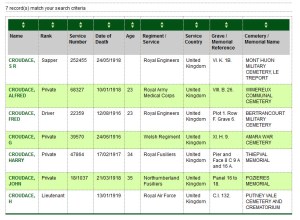
Let’s jump right in and do a search, partially because that is what most people are going to do. From the home page you can do a simple search using: surname; initials; service; and war. For this illustration I am doing a search on the name Croudace, and I choose WWI. I have seven results listed, and this is definitely one of the benefits of an unusual surname. In this case I can examine all seven results by selecting the surname on each line in turn.

John Croudace - Northumberland Fusiliers son of Andrew John Croudcae and Jane Croudace
Search results for surname Croudace on Commonwealth War Grave Commission Website

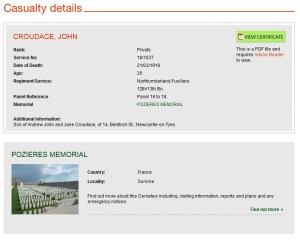
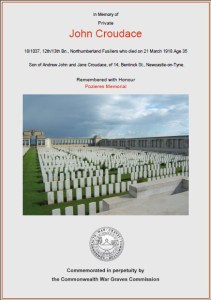
The soldier I actually need is John Croudace.  The results shown are in a standardized format. What you hope and pray for is data in the Additional Information field for without it you may or may not be able to positively identify your serviceman or woman. In this case we learn that John Croudace is the son of John and Jane Croudace, of 14 Bentinck Street in Newcastle-on-Tyne. I have John with his parents (A.J. – Andrew John and Jane Croudace) and siblings at this address in the 1911 census. I have my serviceman.

Details for John Croudace of the Northumberland Fusiliers, son of John and Jane Croudace

The standardized data fields are: name; rank; service number; date of death; age; regiment/service; grave reference, and the cemetery where buried or the memorial where his name is inscribed. There may also be the valuable additional information. The additional information was drawn from the soldiers paperwork where they often, but not always, named parents, or wives. This is especially valuable as many of those documents were destroyed by fire during World War II. I will come back to what has survived of these records in a later post. There can also be extensive information with photographs on the cemetery where the person in buried.

Presentation Memorial Certificate for John Croudace.

In the upper right corner of the casualty details box is a button for – view certificate. This is a very nice certificate to print to remember your serviceman or woman, and to insert into your research files. Please note that one key piece of information is missing from the certificate which would be vital if you are planning on visiting the cemetery or monument. What is missing is the grave reference number, or the panel number of the memorial.

We will take a closer look at this website in the next blog posting.

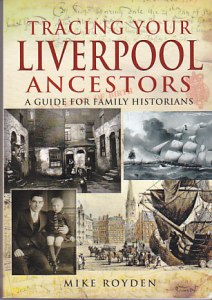
Book Review: Tracing Your Liverpool Ancestors – A Guide for Family Historians by Mike Royden

Tracing Your Liverpool Ancestors: A Guide for Family Historians by Mike Royden

The posting of this review comes as a result of a specific question following one of my recent lectures at the Dupage County Genealogical Society Conference.

Tracing Your Liverpool Ancestors: A Guide for Family Historians. By Mike Royden. Published by Pen & Sword Family History, 47 Church Street, Barnsley, South Yorkshire S70 2AS, UK. www.pen-and-sword.co.uk. ₤14.99. US Distributor: Casemate Publishing, 1016 Warrior Road, Drexel Hill, PA 19026. www.casemateathena.com. $32.95. Australia Distributor: Gould Genealogy & History, P.O. Box 119, St. Agnes SA 5097.  www.gould.com.au. AUS$44.95. 2010. 260 pp. Illustrations, index. Softcover.

Royden is a well-known writer-lecturer and authority on the history of the city of Liverpool in Lancashire, England. That knowledge, experience and advice comes through clearly in this research guide. This book is so clearly focused that it is a must for anyone with Liverpool connections.

The book is divided into two sections; work and economy; society; plus appendices. The book begins by describing the development of the city, beginning with its fishing village origins. It did not begin to develop until after 1647 when it became a free and independent port no longer subject to the Port of Chester. Rapid expansion occurred in the 1660s and 1670s with the expansion of the town, development of local industries, the discovery and development of local salt deposits. Then during the eighteenth century it rose to prominence because of the transatlantic slave trade, along with its growing importance as a port and center of shipbuilding. Until around 1700 Liverpool remained one township within the parish of Walton but land enclosure and land development was changing the rural agricultural area, but the town boundaries did not start to expand until the 1830s, while the close by towns of Birkenhead and Ellesmere Port did not exist yet. The geographical isolation of Liverpool within England changed during the industrial revolution with the development of roads and turnpikes, the construction of canals and in 1830 the opening of the Liverpool to Manchester railway.

The second section focusses on society by examining: housing development; poverty; health and charity; religion and migration; education; and the experience of war. In the process of examining these subjects Royden identifies the history and records of the local institutions and organizations that impacted the lives of our ancestors. No matter at what level of society, what ethnic or religious group your ancestor belonged to he or she will have been influenced by these institutions and local organizations. This book puts everything into local context and directs your research.

What makes this volume different and even more valuable, from other regional guides in this series, is the very frequent and extensive guides to further research and reading attached to every topic discussed in the book. Inter-library loan will give the reader access to most of these resources.

The book concludes with six extensive appendices (71 pages): a research guide – pulls together information on the familiar family history records we search; a listing of archives, libraries and local study centers – providing contact information and identifying their primary holdings; web resources – identifies local history links, local photography sites, and locally focused forums and message boards; other useful organizations and resources – describing purpose, meetings, publications and contact information; museums and heritage centers – contact information and descriptions of holdings ; and recommended reading. It should be noted that even though the recommended reading list is very extensive and arranged by topic making it easy to use, it is not comprehensive and that the relevant section within the text should also be read as often additional recommendations will be made.

Discover English Parish Registers – My new book

I’m pleased to announce that copies of my latest book – Discover English Parish Registers are now available in both print and electronic formats. It is published by Australian publisher Unlock the Past. You can purchase the e-book here for AUS$7.95 and the print copy here for AUS$17 includes GST.
Here’s how the book is described by the publisher. One note to North American readers – it’s written appropriately in the Queen’s English.

English parish records are a fundamental source for English research. In this detailed guide, family historian Paul Milner explains how and why the records were created, beginning in 1538, what the records look like and what information they contain. A well-illustrated case study, with plenty of twists and turns, shows why care is needed to trace back in time from one generation to the next. The guide continues by explaining how and where to access the records (online, microfilm, originals or in print) and concludes by explaining what to do when you can’t find your ancestors in the records.

Here is a practical guide that will help the beginner to avoid mistakes in climbing the family tree, yet the depth and details are here to assist the experienced researcher in understanding how to get the most from parish registers. This publication is a definitive guide to English parish registers that you will wish you had when you first started your research.

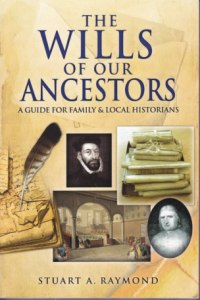
Book Review: The Wills of our Ancestors – A Guide for Family and Local Historians by Stuart Raymond

Wills of Our Ancestors: A Guide for Family and Local Historians by Stuart Raymond

The Wills of Our Ancestors: A Guide for Family and Local Historians. By Stuart A. Raymond. Published by Pen & Sword Family History, 47 Church Street, Barnsley, South Yorkshire S70 2AS, UK. www.pen-and-sword.co.uk. ₤12.99. US Distributor: Casemate Publishing, 1016 Warrior Road, Drexel Hill, PA 19026. www.casemateathena.com. $24.95. Australia Distributor: Gould Genealogy and History, P.O. Box 119, St. Agnes SA 5097, Australia. www.gould.com.au. AUS$34.95. 2012. xviii, 199 pp. Illustrations, index. Softcover.

Almost every book on English research highlights the need to examine the wills of our ancestors. But the devil is in understanding the details and there are lots of them. Mr. Raymond gives us an easy to read detailed guide to understanding and using the wills and associated records of our ancestors.

This book focuses primarily on English and Welsh probate records from the medieval period through to 1857, although the post 1857 wills, along with the parts of the British Isles are discussed, but in less detail. The book’s introduction discusses the value of probate records, what has survived, their origins (separate meaning of will and testament and how they got combined after 1540), probate law, along with their limitations and biases, plus a community case study. That is all in the introduction.

There are separate chapters addressing: who could make wills and why they made them; the probate process; what is likely to be found in the will (and why it needs to be treated with care); the contents, value and limitations of inventories; other probate records (litigations, act books, commissions, administration bonds, probate accounts); plus where and how to find the probate records. The book continues but with less detail on the post 1857 wills, and probate records from around the rest of the British Isles. There are a number of other groups of records outside the church and civil courts that contain probate materials and these are each addressed giving the researchers alternative sources.

There is an excellent further reading section that provides an annotated bibliography of books about the probate process, records, and guidebooks but also identifies published collections of probate records arranged by counties, and specific locations within the counties. The problem is that the listing is not complete and you might not know that unless you read everything because in the annotated section for the book by Gibson and Churchill it states – “This volume also lists numerous indexes, both published and unpublished, which are therefore not listed in the present volume” (p.109), although some of the publications in Gibson and Churchill are included here.

The appendices include: summary lists of pre-1858 probate courts, arranged by county, which can be complicated and the author makes no claim for total accuracy; guidance of where to find assistance with handwriting and Latin; a glossary of terms found in probate records; Latin glossary; and a very useful listing of legislation affecting probate.

Pen and Sword have hit another home run, with another great addition to their family history series. This book will be of value both to the beginner and the more experienced researcher.

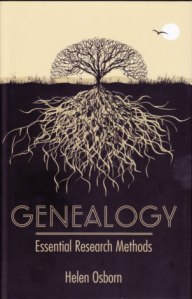
Book Review: Genealogy – Essential Research Methods by Helen Osborn

Genealogy: Essential Research Methods by Helen Osborn

Genealogy: Essential Research Methods. By Helen Osborn. Published by Robert Hale, Clerkenwell House, Clerkenwell Green, London EC1R 0HT, UK. 2012. 272 pp. Hardcover. ₤14.99

Finally, here is a research methodology book written from a British perspective. Yes, there have been a few in the distant past but this one is the first to appear in many years and it is catching up with genealogical scholarship. The book openly acknowledges that in the British Isles the emphasis is on explaining and describing the records, not how to pull everything together is one tight thoroughly researched process.

The book provides advice and inspiration on methods and problem solving skills to help the family historian understand what successful professionals do to get results and why they should be copied. The book is divided into ten chapters: (1) provides an overview of the common challenges we all encounter; (2) explores the search process and examines an effective search actually consists of; (3) and (4) look at how you can go about finding the right source and start to understand their context; (5) asks you to consider whether someone else has already solved your problem for you, and where you can look to find out; (6) shows you how to analyze a document to make sure you really are making the most of your sources once you find them; (7) looks at problem-solving using analysis and a research plan; (8) is about recording your information correctly; (9) is all about organization and presenting your results; (10) discusses the important question of how to prove family connections by using good proof standards in your research.

The book does an excellent job of getting the reader to think about what the research process is and how it can be improved and understood better to get good results.

I liked the book, it gets the reader thinking about how to improve what they do, but in some ways it lets the researcher off the hook. Let me explain. The one part of the book I found myself reacting negatively to deals with documentation and citing sources. Ms. Osborn gives three examples of the same family group sheet: undocumented; documented; and what she calls hyper-documented. The implication to the beginner by the choice of these titles is that the documented is satisfactory, when in reality it is not. The so called hyper-documented is what would be regarded as well or properly documented and would leave a good trail for researchers to follow. The text suggests the hyper-documentation is an extra step encouraged for those planning to publish, not a standard to be encouraged for all good researchers.

Book Review: Marriage Law and Practice in the Long Eighteenth Century – A Reassessment by Rebecca Probert

Marriage Law and Practice in the Long Eighteenth Century – A Reassessment by Rebecca Probert

Marriage Law and Practice in the Long Eighteenth Century: A Reassessment. By Rebecca Probert. Published by Cambridge University Press, The Edinburgh Building, Cambridge CB2 8RU, UK. www.cambridge.org. 2009. xii, 358 pp. Index. Hardcover. $113.

 This book radically changes our understanding of English marriage law, destroying most of what has been taught by historians and genealogists regarding marriage law in the past. This book is one volume in a series entitled Cambridge Studies in English Legal History and is therefore not a light read, but is certainly worth the effort. If you want an overview of Ms. Proberts’ arguments then read her Marriage Law for Genealogists: The Definitive Guide that I reviewed earlier. If you want more details including the specifics on the case law read this volume.

 Ms. Probert is a genealogist and Professor of Family Law at Warwick University, a leading authority of the history of marriage laws of England and Wales and it clearly shows here. Her arguments in this book for her case are through and backed up by legal, historical and genealogical research which makes the book fascinating to read.

A very strong case is made that the 1753 Lord Hardwicke’s Act did not constitute a radical break with the past, but rather it was a transition from canon law to English law. In many ways the new Act focused on enforcing what was already supposed to be happening and as the formal title suggests “Act for Preventing Clandestine Marriages” it was primarily aimed at one particular practice – ending Clandestine Marriages.

 The book focuses on the decades before and after the Act and how the contemporary people, church and legal establishment viewed marriage. It is vitally important to use contemporary sources for it is the legal establishments in both England and America that have really muddied the waters and led many historians astray.

 The book examines in detail the misunderstandings around contract per verba de praesenti, clearly defining in the process what constituted a marriage in the eyes of the church and the law. It addresses other perceived marriages practices, tracing the origins of each into the historical literature and destroying each along the way. Ms. Probert moves on to explain what a clandestine marriage is and why it was such a problem for the establishment, and for the people involved. Once defined the book looks at the passage of the Act, what the law said and what effect it had on practice. Examined are the terms of Act; contracts to be unenforceable; preliminaries to the marriage; parental control; the ceremony; registration; penalties; exemptions. It would have been a nice addition if a full copy of the Act had been included in the book.

The book concludes by examining the success of the Act, how it was interpreted afterwards by the judicial system and what the response was at the time by the non-Anglicans.

For the genealogist three sets of records are used to support her case regarding marriage practices: specific cohorts of couples drawn from baptismal registers in a variety of locations around England and Wales; settlement examinations (Bradford-on-Avon, Wiltshire); and a rare parish listing (1782 Cardington, Bedfordshire).  

The book is heavily footnoted throughout citing numerous legal, historical, genealogical and social texts and studies. These provide lots of alternative viewpoints. However, this reviewer thinks the arguments have been made soundly, are strongly supported, and all genealogists should rethink what they have been taught about English marriage laws and practices in the eighteenth century. This is a good read


Veterans Day – fun video

Veterans Day is an important time of the year to remember all our veterans. I could write a lot about military ancestors and will be over the next year as we move towards the 100th Anniversary of the start of World War I.

However today I want to share a fun video with an army flashmob playing Colonel Bogey in the Capitol Shopping Market in Cardiff. Enjoy.

http://www.liveleak.com/view?i=a7e_1381073342


Book Review: A Tour of the English Lakes with Thomas Gray and Joseph Farrington RA by John R. Murray

Thomas Gray - Elegy Written in a Country Churchyard
A Tour of the English Lakes with Thomas Gray & Joseph Farrington RA by John R. Murray

A Tour of the English Lakes with Thomas Gray & Joseph Farrington RA. By John R. Murray. Published by Frances Lincoln Ltd, 4 Torriano Mews, Torriano Avenue, London NW5 2RZ, England. www.franceslincoln.com. 2011. 159 pp. Illustrations. Hardcover. £25 or $45. 

Thomas Gray has almost been forgotten except perhaps for this Elegy Written in a Country Churchyard. Yet, his journal is regarded by many as the first example of modern travel writing. His journal covers a number of journeys, but in 1769 he traveled through the English Lakes, now known at the Lake District. The journey reported here is a transcription of the journal but also an account from four letters to a friend Dr. Thomas Wharton, which was needed to fill in a gap in the journey. The journey took fifteen days, and covers 17 pages of the book. It is an excellent portrayal of travel in this time period and is relatively easy to picture if you are familiar with the area. The book includes sample pages from the manuscript showing tight clear writing and detailed sketches.

     A few years later, the artist Joseph Farrington made a similar tour following in Gray’s footsteps, painting what he saw along the way. These paintings included water colors and ink-and-wash (sepia) sketches. A number of these plus engravings of these scenes were published in 1789 and 1816. For this volume those paintings relating closely to Gray’s journey have been selected to create a visual tour of the Lakes. They are arranged by locality showing different scenes around the Lakes: Ullswater (6); Derwentwater (9); Bassenthwaite (1); Thirlmere (2); Grasmere and Rydal Water (5); Windermere (6); plus some supplemental drawings. The location of each viewpoint is indicated on maps reproduced from Peter Crosthwaite’s Maps of the Lake District, originally published in 1794. For each of the localities chosen there is usually a two page spread showing the watercolor, engraving and a modern photograph from as near to the painters viewpoint as possible, plus explanatory text or a descriptive quote that accompanied the 1816 publication of the images. Many of the photographs are spot on with little changed in the scene, though a number of the photographs needed to be taken from slightly higher elevations because of modern tree growth.

     For anyone with ancestors in the Lake District who wants to get a feel for what the countryside was like before the roads developed, or the tourists arrived, or for ancestors who made the tour to the Lakes, then this beautifully illustrated book will help put them into context. The book also provides a good bibliography on the early history; the artists, writers and tourists who traveled in the area.