Discover English Parish Registers – My new book

I’m pleased to announce that copies of my latest book – Discover English Parish Registers are now available in both print and electronic formats. It is published by Australian publisher Unlock the Past. You can purchase the e-book here for AUS$7.95 and the print copy here for AUS$17 includes GST.

Here’s how the book is described by the publisher. One note to North American readers – it’s written appropriately in the Queen’s English.

English parish records are a fundamental source for English research. In this detailed guide, family historian Paul Milner explains how and why the records were created, beginning in 1538, what the records look like and what information they contain. A well-illustrated case study, with plenty of twists and turns, shows why care is needed to trace back in time from one generation to the next. The guide continues by explaining how and where to access the records (online, microfilm, originals or in print) and concludes by explaining what to do when you can’t find your ancestors in the records.

Here is a practical guide that will help the beginner to avoid mistakes in climbing the family tree, yet the depth and details are here to assist the experienced researcher in understanding how to get the most from parish registers. This publication is a definitive guide to English parish registers that you will wish you had when you first started your research.

Digital Microfilm at TNA – changes coming – Army Lists as example

Digital Microfilm at TNA, currently Free, but changes are coming

Given my last post about the indexing of WWI war diaries, I was in this post going to explain how to download the war diaries that had already been scanned and were available as part of The National Archives website. I had downloaded war diaries in October 2013, but I can’t do it now. I thus spent the week learning a little more about what is happening regarding digital images at TNA.

Firstly, I learned that the war diaries are in the process of being digitized at a higher quality. They will then be repackaged, improved and put online again. I suspect with a different fee structure.

I also learned by reading the minutes of the TNA User Advisory Group that changes are coming to the Digital Microfilm currently available online for free. It is the Army Lists in WO 65 that are specifically mentioned in the minutes. I confirmed by contacting a committee member that changes are coming. Specifically WO 65 will be removed, repackaged and put online for a fee. Nothing was disclosed about what the repackaging what look like, what the fee would be, or when this would occur. It was suggested that if I wanted copies of the Army Lists for free that I should do it soon.

To get to the complete list of Digital Microfilm click here. This will take you to a description page and a long list (getting shorter) of digital microfilm that you can download free from a variety of record groups. Scroll to WO 65 – Printed Annual Army Lists. The published army lists begin here in 1754 with WO 65-1 and end chronologically with 1878-79 WO65/163. However, at the end of the chronological lists are an additional five films of British American Half Pay lists and Foreign Corps. What is different about these printed Army Lists is that they are the ones that were actually used by the War Office. These volumes are annotated, often indicating changes for you to look for in the following year.

The published annual Army Lists is often the first primary source you will use to reconstruct the promotions for any Army Officer.  It is thus a valuable source. I am not suggesting that you download every volume available. These can be very big files. What I am suggesting is that you may want to consider downloading the volumes for any specific period in which your ancestor/s may have served. In addition to that I am also downloading sample volumes from other periods so if I later find or suspect another family connection I can dip into the lists for free. I understand that there will be a charge in the future.

Have a look at the rest of the digital microfilms to see what others may be of interest to you and get them now. Some of them are fully indexed in the Discovery catalog – WO 76 – Records of Officers Services. As an outsider this would be another obvious one for a commercial partner to index, slice and dice and of course then charge you to access the record.

Have a look at the Digital Microfilms, which are currently free and see what might be beneficial to your research.

WWI: Operation War Diary – Your Help Wanted

Operation War Diary - Joint project between TNA, IWM and Zooniverse to index WWI Diaries
Operation War Diary – Joint project between TNA, IWM and Zooniverse to index WWI Diaries

WWI: Operation War Diary – Your help wanted

Operation War Diary is a new joint project between The National Archive (providing the documents), the Imperial War Museum (providing the historical expertise) and Zooniverse (providing the technology community software) is recruiting citizen historians to index these war diaries. The project is online at www.operationwardiary.org.

During WWI each unit kept a war diary. There are over 1.5 million pages within these diaries telling the stories of what was happening on any given day during the war. This is where you have the opportunity to put your soldier into context. The diaries originated as a result of Field Regulations Part II issued in 1909 and reprinted in 1913, stipulating the purpose of the war diary and how the diary was to be completed. However, every diary is different. The goal of this new project is to “classify each page of every diary”.  Indexing the war diaries will reveal questions about: military activity; people; weather; army life; and casualties.

The website provides a Field Guide to the diaries with examples of the different pages – cover, diary, orders, signal pads, reports and other documents (e.g. maps) and lists what is hoped will be tagged and indexed on each of these pages. There is a 10 minute tutorial on how to tag and index, which is very good. You will need to register first and then you can start tagging. Currently 31 diaries are online in various levels of completion. The site states that eventually everything from Operation War Diary will be available to everyone free of charge.

The stated purpose is to “classify each page of every diary”, however on the About Us page is states that The National Archives has digitized the war diaries of the units under the command of the British and Indian cavalry and infantry divisions on the Western Front. This makes me wonder if other Fronts such as Gallipoli or Mesopotamia will be included later. Personally I hope so as I have a soldier dying at El Kut in Mesopotamia and I would like to read that war diary.

There is also a discussion section where images can be posted of problem pages, help requests, or exciting finds. This is a very active section, for example 12 images with questions posted within the last hour.

I have read some war diaries in the past, but logging in and starting to tag the data really helps you appreciate the depth of details that are here about the lives of our soldier ancestors. The process was simple, fun and educational. If you have WWI ancestors, come join us in this worthwhile project.

WWI Centenary Preparations by Commonwealth War Grave Commission

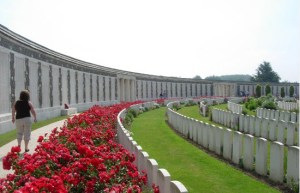
Tyne Cot Memorial, Ypres, Belgium

WWI Centenary Preparations by Commonwealth War Grave Commission
I mentioned in my opening post for 2014 that this year I would be taking a look at some of the WWI military records available to family historians in detail. The Centenary is going to be a big event over the next five years as we recall what happened and the effect it had on our families. One of the institutions highly involved in the centenary is the Commonwealth War Gave Commission (CWGC). We will learn more about their records later.

The Commonwealth War Grave Commission maintains and cares for cemeteries, monuments and memorials in over 24,000 locations in 150 countries, all commemorating Commonwealth men and women who have died in a branch of the military service since the start

of WWI. The sites may be a single headstone or a large cemetery such as Tyne Cot at Ypres in Belgium with over 7,500 headstones. Visitors to these sites have been increasing and are expected to increase dramatically with the centenary.

To prepare the CWGC has identified five “iconic” sites in France and northern Europe. These are Tyne Cot (Ypres, Belgium), St. Symphorien (Mons, Belgium), Nieuwpoort Memorial (Flanders, Belgium), Menin Gate (Ypres, Belgium), and Island of Ireland Peace Park (Messine, near Ypres, Belgium). The preparations include: replacing and re-engraving of headstones; renovating and replanting borders and gardens; replacing panels and renewing paint in the engraved names on memorials, and much more.

More details about the preparations can be read in a story entitled “War Graves commission face major WWI challenge” from December 28, 2013 issue of The Scotsman.
The CWGC publishes a monthly newsletter keeping readers informed about what is happening around the world. One story in the January 2014 issue that caught my attention referred to a grave site being located for a British Airman – Second Lieutenant Philip Frederick Cormack, 204th Squadron, Royal Air Force who until now has been commemorated on the Arras Flying Services Memorial (meaning there is no known grave). He is in fact buried in the French Military Cemetery in Machelen, East-Flanders in Belgium. The CWGC continues to identify and locate the bodies of the fallen.

Thanks to Chris Paton at The British GENES Blog (Genealogy News & EventS) for bringing both these items to my attention.

2014 Plans for the Future

2014 Plans for the Future

In my last post I reflected on the happenings of 2013. In this post I will use the same themes and share what I have planned for 2014.

Blog and Writing – On the blog I will continue to highlight and review new online and print resources. If there is a topic that you would specifically like to know about let me know and I will see how if I can point you towards good resources.

In addition I want to focus on the fact that 2014 is the centenary of the start of World War One. Almost anyone with family connections in the British Isles in 1914 will have someone who served in the war or was affected by the war. All the new online indexes are making it so much easier to find family members who served in one of the branches of the armed services or the auxiliaries. What I am finding though is that students don’t appreciate what they have found, what the records contain, or what clues they provide to go to the next step. I plan on examining some of the records in detail and demonstrating how to go further.

I am also working with a good friend, a technologically savvy genealogy blogger, to provide mutual support to write for our blogs on a consistently regular basis. The hope and expectation is that we will both post on a more consistent schedule.

In other writing, I am working on a manuscript explaining the records within the English Parish Chest, to be published by UnlockThePast. I will let you know when my new book, already with the publisher – Discovering English Parish Registers becomes available.

I will also continue doing my reviews for the Federation of Genealogical Society’s FORUM magazine, plus for the newsletter of the British Interest Group of Wisconsin and Illinois (BIGWILL).

Genealogical Speaking – I teach an English track and a Scottish track at the Institute of Genealogy and Historical Research at Samford University in Birmingham, Alabama as part of a three year cycle with David Rencher teaching the Irish track this year. This therefore is my year off while David teaches.

Instead I will be teaching a week long program for the 2014 British Institute – Scottish Research: Understanding the Fundamentals and Beyond – October 20-24 in Salt Lake City for the International Society for British Genealogy and Family History. Plan on coming to join me for what will be a great learning opportunity. I will also be lecturing at both national conferences – National Genealogical Society conference in Richmond, Virginia (May 7-10) and the Federation of Genealogical Societies Conference in San Antonia, Texas (Aug 27-30). In addition there will be a number of regional and local events. Keep an eye on my schedule for a more complete itinerary.

Personal Research – I hope to make some time for my own research, especially my Milner, Finnigan and Doran lines. I will try to share some of their stories. I will be using my World War One focus to explore and learn more about my many family members who served and died during the war.

Please Join Me in this journey by reading my blog regularly, which you can do by subscribing to the RSS feed or subscribing to an email version of this blog. If you know fellow researchers with a British Isles interest do not keep me a secret, let them know you are reading my blog and suggest they may enjoy it.

Happy Hogmaney to all my readers. Let’s all enjoy 2014 and do good research.

Letters of 1916: Creating History

Letters of 1916: Creating History Project from Trinity College Dublin

Letters of 1916: Creating History

Do you have letters to or from anyone in Ireland written in 1916. Then you may want to share them with the Letters of 1916: Creating History project at http://dh.tcd.ie/letters1916/

Quoting from the website’s home page – “The Letters of 1916 project is the first public humanities project in Ireland. Its goal is to create a crowd-sourced digital collection of letters written around the time of the Easter Rising (1 November 1915-31 October 1916).”  In the first two months of the project over 500 letters were uploaded from both national institutions and private collections. The Letters 1916 team is identifying, digitizing and preparing hundreds more for uploading.

The project is being coordinated by researchers at Trinity College Dublin and they are calling upon members of the public to upload old family letters and photographs to the new digital archive. It is intended that all the letters, transcripts and images will be launched in 2016 for the centenary of the East Rising.

Even if you don’t personally have letters to share, you can get involved by volunteering and transcribing some of the letters. You can even choose which types of letters or topics interest you. The letters are arranged by categories – Easter Rising Ireland 1916; Art and literature; Business; Children; City and town life; Country life; Crime; Faith; Family life; Irish question; Last letters before death; Love letters; Official documents; patronage; Politics; World War I – 1914-1918. Some of the letters are very short and easy to transcribe. One letter I looked at from the World War one category was a simple thank you for bread received, so even the apparently mundane letters are included if they fall within the desired time period.

One of the keys to this project is that it will highlight the thoughts, ideas, and feelings of the ordinary Irish man and woman, along with what was happening officially.

The project was officially launched 27 September 2013, at Trinity College Dublin. If you would like to read the full press release you can do so at http://dh.tcd.ie/letters1916/wp-content/uploads/2013/09/1916-Letters-Press-Release-27-September-20131.pdf

Institute of Genealogy and Historical Research: Scottish Research Track

Institute of Genealogy and Historical Research, June 9-14 at Samford University, Birmingham Alabama.

I am excited as next week I get to teach a whole week course on Scottish Research. IGHR as it is more familiarly known is the longest running Genealogical Institute in North America, and possibly the world. It has been operating for over 45 years. There are 10 education tracks running simultaneously. Courses for England, Scotland and Ireland are offered on a three year cycle. I coordinate and teach the English and Scottish courses, while David Rencher, the Chief Genealogical Officer for FamilySearch teaches the Irish course.

This will be an intense week for the 25 adult learners in the class. 19 lectures with computer class time over the 4.5 days of the Institute.

•    Scotland — Definitions, Sources, Repositories and Processes
•    Scottish Emigration to North America
•    History of Scotland
•    Scotland — Internet: Commercial Sites
•    Scotland — Internet: Free Sites
•    Find the Correct Place: Maps and Gazetteers
•    Civil Registration
•    Making Sense of the Census
•    Church Records for B/M/D
•    Kirk Session and Poor Relief Records
•    Inheritance: Wills and Executries
•    Inheritance and Transfer of Land/Buildings
•    Burghs and Their Records
•    Occupation Records
•    Scots in the British Military (2 sessions)
•    Overlooked Sources: 17th and 18th Centuries
•    Overlooked Sources: 19th and 20th Centuries
•    Planning your Trip to Scotland

Think about IGHR for your future educational needs as it is too late to register for this year


Irish Treasure Trove in the News

We can’t get through the Irish celebrations of St. Patrick’s Day without a good Irish story. Here is an excellent article from the New York Times about the personal collection of a fishmonger from Ballina, County Mayo, Ireland that is being cataloged by Sinead McCoole. It’s a job where where she set aside six weeks to catalog and find the best for an exhibition. Now eight years later she is still working on what has become known as the Jackie Clarke Collection with more than a 100,000 items focusing on the retelling of Ireland’s long struggle to free itself of British rule.  The collection includes “fragile maps and rare newspapers, political posters and editorial cartoons, books, diaries, photographs, films and even a scrapbook.”  It’s an interesting story and worth a read. You never know what you might find in your Irish research.

Thanks to Beth Finch McCarthy for bringing this to my attention.