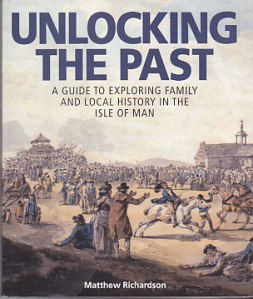
Book Review: Unlocking the Past: A Guide to Exploring Family and Local History in the Isle of Man by Matthew Richardson.

Unlocking the Past – A Guide to Exploring Family and Local History in the Isle of Man by Matthew Richardson

This review got posted as a result of meeting two special ladies in Cumbria looking for research resources for the Isle of Man. I hope this helps.

Unlocking the Past: A Guide to Exploring Family and Local History in the Isle of Man. By Matthew Richardson. Published by Manx National Heritage, Kingswood Grove, Douglas, Isle of Man 1M1 3LY, British Isles. www.gov.im/mnh/. 2011. 210 pp. Illustrations, index. Softcover. £12.

Geographically the Isle of Man is part of the British Isles. It is a Crown Dependency owing its allegiance to the British Crown with Her Majesty Queen Elizabeth II holding the title Lord of Mann. But the island has never been part of the United Kingdom. What this all means for the genealogist is that things are done differently there. Yes, there are a lot of similar records, but beginning and ending dates, access procedures, contents and relative importance are often different than we are used to finding in England.

The book opens with a historical overview of the Isle of Man, from the early native Celtic population to the present time, which will be especially valuable for outsiders, like most North American readers. The second part is a detailed guide to the main Isle of Man repositories, providing names, addresses, contact information and a summary of what is likely to be found there. The bulk of the book is a guide to areas of research, arranged alphabetically, and being one to eleven pages in length.  The topics include: Castle Rushen (prison) papers; cemeteries; census; church court records; court records; customs records; directories; emigration records; folk life survey; friendly societies; internment records; land and property records (two large important geographically separated collections); mapping; military and naval records; mining records; rolls office records; shipping company and shipping records; and more for a total of 53 different topics. For each topic you get a detailed description of the records, how and why they were created, where they are now and how to access them, and where they fit in context. Many of the topics are illustrated and contain examples of the types of information found in them.

The book concludes with five case studies tracing the context and ancestors of a: miner; soldier; broadcaster; housekeeper; and blacksmith. These case studies show how different records can be pulled together to create a good family picture, and they are well worth reading.

The book is lavishly illustrated throughout, provides a bibliography and is indexed. This book is current, tells what is coming, and is a good replacement to The Manx Family Tree by Janet Narisimham, originally published in 1986, with the 3rd ed. in 2000.

Anyone searching for ancestors or investigating the history of the Isle of Man will find this book beneficial.
Exodus: Movement of the People Conference – Hinchley, Leicestershire, England

I leave today to travel to Hinchley in Leicestershire England to speak at the Exodus: Movement of the People Conference on 6-8 September. The focus is on the story of migration from, to and within the British Isles.
The three day event provides a who’s who’s of lecturers from the genealogy and academic history community from around the world all focused on one subject – British migration. There are twenty-one sessions given by eighteen speakers. I am giving two lectures:
Scottish Emigration to North America: Before, During and after the Rebellions
Irish Emigration to North American: Before, During and after the Famine.
If you are interested in seeing the program have a look at www.Exodus2013.co.uk. I am interested in seeing in what ways the British events are different from the American, Canadian and Australian events at which I have spoken. I will provide some feedback.

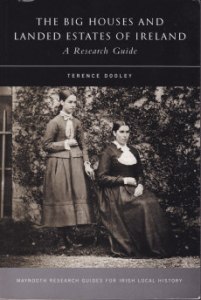
Book Review: The Big Houses and Landed Estates of Ireland – A Research Guide by Terence Dooley

The Big Houses and Landed Estates of Ireland: A Research Guide by Terence Dooley

A question about the records associated with Landed Estates in Ireland was raised in a casual conversation in the exhibit hall at last week’s FGS conference in Ft. Wayne, IN. I hope you find this review helpful.

The Big Houses and Landed Estates of Ireland: A Research Guide. Maynooth Research Guides for Irish Local History: Number 11. By Terence Dooley. Published by Four Courts Press, 7 Malpas Street, Dublin 8, Eire. US Distributor: International Specialized Book Services, 920 NE 58th Avenue, Suite 300, Portland OR 97213. www.isbs.com. 2007. 192 pp. Illustrations, index. Softcover. $24.95.

This new book is a valuable tool for those with Irish connections for the majority lived on the landed estates, whether they were the landed magnates owning tens of thousands of acres; middlemen leasing large tracts of land from head landlords and renting them in turn in smaller parcels of various sizes to tenant farmers; cottiers who exchanged their labor for half an acre or so of potato ground; landless laborers who worked on estates or farms; or the big house or demesne servants. The estates themselves varied greatly in size from the smallest of around 500 acres to those such as the Marquis Conyngham who owned 160,000 acres. The smaller estates were generally in one county but the larger ones could have parts in many counties, making the locating of records more problematic.

At the heart of the approximately 7,000 landed estates in nineteenth-century Ireland is the “big house” built to announce the economic and social strength of their owners in the locality and in the class as a whole, and to inspire awe in social equals and possibly encourage deference in the lower classes. Even the houses on the smaller estates were big in comparison to any house inhabited by the tenant farmers, cottiers or laborers. The term “big house” also captures some of the historical resentment that was felt towards the people in these houses by nationalist Ireland, especially after the land wars of the 1880s.

This is a practical book, opening with a broad outline of the history of landed estates in Ireland from their growth in the sixteenth century to their break up in the twentieth, with particular attention given to outside influences affecting life on the estate. Researchers are directed towards the important published sources. The third chapter provides a historiography of the big house describing the growth, consolidation and decline over four centuries. The author highlights the need to be aware of local anomalies not always identified in broad national generalizations. Doing the background reading in these two chapters will provide the wider social, economical and political historical contexts for family historians and provide an understanding into whether what occurred on a particular estate was typical or peculiar to that estate.

Chapters two and four describe the important primary sources available for the study of the estates and their houses, highlighting the strengths and weaknesses of each which is very valuable if as a researcher you are accessing them for the first time. They do point out that not all records discussed survive for all estates. Many of the records will be familiar like Griffith’s Valuation, Tithe Applotment books, directories, gazetteers, and deeds. But the less familiar sources might include: estate records; parliamentary papers; records of the Irish Land Commission and Congested Districts Board; encumbered estates; memoirs; travelers guides; newspapers; architectural archives; maps; paintings and topographical drawings; even contemporary fiction. The references to publications and websites are useful and current. The index is good, but a comprehensive bibliography would have been a nice way to pull together the many citations in the footnotes. This is an excellent book, highly recommended, for researchers wanting to go beyond the basics and those seeking to put their ancestors into context.

Book Review: Scottish Catholic Family History by Andrew R. Nicholl

ScotlandsPeople Catholic research
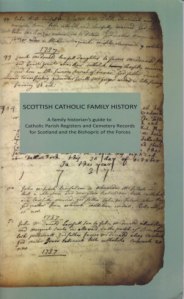
Scottish Catholic Family History: A family historian’s guide to Catholic Parish Registers and Cemetery Records for Scotland and the Bishopric of the Forces by Andrew R. Nicholl

This post came as a result of questions in a lecture I gave this morning on Effective use of ScotlandsPeople Website at the Federation of Genealogical Societies Annual Conference in Ft. Wayne Indiana.

Scottish Catholic Family History: A Family Historian’s Guide to Catholic Parish Registers and Cemetery Records for Scotland and the Bishopric of the Forces. By Andrew R. Nicholl. Published by The Aquhorties Press, Columba House, 16 Drummond Place, Edinburgh EH3 6PL, UK. www.scottishcatholicarchives.org.uk. 2011. 115 pp. Illustrations. Softcover.  £10.

The Catholic Parish Registers Project began with a focused plan – to digitize and index all pre-1855 Catholic parish registers that existed. Digitization continued beyond this date because volumes continued beyond 1855, post-1855 registers had been deposited at the Scottish Catholic Archives; plus the records of the Bishopric of the Forces, Dalbeth Cemetery in Glasgow and Mount Vernon Cemetery in Edinburgh were fully available. If the records survive in the Scottish Catholic Archives they have been digitized, though there may be more modern records still in the Catholic parishes around Scotland. The latter have not been sought after to be added to the collection at this stage. This collection is much more extensive that the photocopy collection of Catholic registers that exists at the National Records Scotland (former National Archives of Scotalnd).

In the collection there are the usual parish registers of births/baptisms, marriages and deaths/burials/funerals, each with 100, 75 and 50 years closure periods respectively to protect privacy. Other items in the collection, all with a 100 year closure, include: confirmations; confessions; converts; communicants; status animarum (“state of souls” – often a list); seat rents; and sick call. The book begins by describing all the different record classes, itemizing what they are likely to contain and showing an example.

The largest section of the book is the detailed lists of the records.  The lists are arranged by location of the parish and the saint to which it is dedicated. For each location it identifies the type of register, dates covered and the collection reference at the Scottish Catholic Archives. There is the Missions and Parishes Collection, plus the Individual Missions Collection and the researcher needs to check both lists for complete coverage of any given locality.  For the three major Catholic cemeteries in Glasgow and Edinburgh that are included there are internment registers, owners’ registers and lair registers, all of which can provide different information. The Bishopric of the Forces records are the Catholic records from the British military all over the world, unfortunately many of these still fall under the time closure rules.

The last section in the book is a directory, with maps, of Catholic parishes in Scotland. The directory in table format provides: name of the town and dedication of the church; the unitary authority; diocese; date the mission was founded; date of the church building. For most researchers, unfamiliar with Scottish geography, it is the maps locating the churches that will help us identify the parish records worth investigating for our ancestors. One additional aid included is a comprehensive Latin-England forename glossary with all case endings making it easy to distinguish the Latin variants for Patrick and Patricia or Terence and Teresa or other similar male and female names.

If you have searched ScotlandsPeople and found your Catholic ancestors you are fortunate. The bigger problem is if you have searched and not found them – is it because they are not there, the records have not survived, or you are just looking under the wrong name. It is this book that will help you identify the time or record gaps in any specific parish. This book is therefore very important for anyone working on Scottish Catholic ancestry.

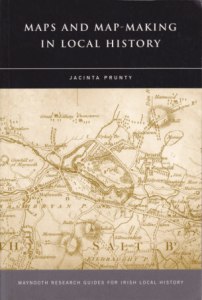
Book Review: Maps and Map-Making in Local History

Maps and Map-Making in Local History by Jacinta Prunty

I am in the process of updating a lecture on Irish Maps to be given at the 2013 Federation of Genealogical Societies Conference in Ft. Wayne, Indiana. This process reminded me of what is probably my favorite book about maps and I thought readers may also want to know about it.

Maps and Map-Making in Local History. Maynooth Research Guides for Irish Local History. By Jacinta Prunty. Published by Four Courts Press, 7 Malpas Street, Dublin 8, Eire. US Distributor: ISBS, 920 N.E. 58th Avenue, Suite 300, Portland OR 97213. www.isbs.com. 2004. 344 pp. Illustrations, index, maps. Softcover. $30

This book opens with the quote: “Maps are graphic representations that facilitate a spatial understanding of things, concepts, conditions, processes or events in the human world” (p.15). The rest of the book expands upon that theme, successfully introducing the reader to the use of maps in research, writing and presenting local history. The illustrations are all from Ireland, so it is especially valuable for those researching in Ireland, but the concepts and ideas introduced are applicable for anyone working with maps. In fact two of the appendices are worth the price of the book alone, simply because they do apply to any location —  “Questions to be asked of maps” and “Questions to ask of your place in the search for maps”.

This is essentially a practical guide, including notes on the map series that are immediately useful for local history, and thus family history in Ireland, plus information on the major repositories, catalogs and finding aids, ways to use the maps in research, and the ways the maps themselves were made. Maps provide the context in which family historians place families within a community. In local history, researchers examine how that community operated in relationship to its neighbors, what resources were shared, how the interactions and development was affected by the landscape, all of which can be seen with maps.

The book is divided into four sections. The first, and largest, provides a historical overview of map-making in Ireland. The watershed here is the six-inch to one mile Ordnance Survey maps. Their production, content and legal standing are described in detail. The maps created before and after this significant series are also thoroughly described. This section is well illustrated and provides researchers with a glimpse of what is available. The author suggests, in the process, that the researcher should obtain any and all maps for the relevant geographic area, regardless of the time period or the maps focus (e.g. railways, canals, roads, military, plantation, geology, antiquities, estates, or bogs).

A very practical chapter on map-reading skills discusses scales, projections, orientations, national grid, grid references, sheet numbering, height, contours, boundaries, measurements, dates, and symbols. Ms. Punty explains where to locate maps, how to get started, and how to use guides to local and major archives or library collections, some of which are online. The book concludes with some case studies on how maps can be used by historians, local and family. This last section of the book also addresses the issues of copyright ownership, and provides guidelines for making your own maps, with or without computers. Many references to published and online materials provide further guidance throughout the text for researchers wanting to explore Irish maps and map-making further.

There is no doubt that this will become the standard guide for anyone working with Irish maps. It is highly recommended for personal and society collections.

Unlock the Past Genealogy Cruise – Inside History article

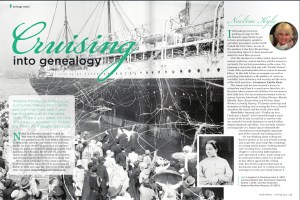
Cruising into Genealogy
Cruising into Genealogy article from Australia’s Inside History vol. 17 p. 64-67

Inside History – Unlock the Past Genealogy Cruise

Unlock the Past’s 2014 genealogy cruise is being highlighted in Australia’s Inside History magazine. The current issue, number 17, is previewed online at http://issuu.com/insidehistory/docs/inside_history_issue_17_issuu and includes a 4 page article (pages 64-67) about the upcoming 9 day cruise, 4-13  February 2014 from Sydney to Melbourne, Adelaide, Hobart and back to Sydney. The article presents interviews with four of the upcoming speakers Noeline Kyle, Neil Smith, Thomas MacEntee, Chris Paton and it looks like a great event.

If you like the preview of the current edition of Inside History you can see a full edition at http://issuu.com/insidehistory/docs/free_inside_history_issue_8

Unlock the Past has additional long and short cruises planned for 2014 and 2015. If you want to check out more details have a look at www.unlockthepastcruises.com.

As the keynote speaker on this year’s cruise I can tell you that this is a great way to travel, see new places, have a genealogy conference with great speakers and make lots of new friends. Because the atmosphere is relaxed you have the opportunity over meals or drinks to sit and talk and discuss genealogy to your heart’s content. The cruise also provides your non-genealogy spouse or family members with lots of alternative activities and shows.

Take a look at Unlock the Past’s offerings as it may open new doors and adventures for you

Tim Ellis Interview

Tim Ellis is a name you may not recognize. He is the Keeper of the Records of Scotland and Registrar General for Scotland.  In this important role he could have an important role in terms of what happens in Family History in Scotland. Mr. Ellis is interviewed in Issue 26 of Broadsheet the online publication of the Scottish Council on Archives.

In the interview one question asks if he sees particular opportunities for cooperation across registration and archives services in Scotland. One part of his answer bodes well for the future – … ScotlandsPeople is a genuinely great service. And ScotlandsPlaces is also a growing resource. I’m impressed by what I’ve seen of the work of other Scottish archives in the digital sphere, too – but I do wonder if there’s scope for us all to work a bit better together to overcome some of the barriers and maximise the reach and benefit of what we’re doing.

Another question revolves around what he would do with an unlimited budget – … I’d probably start by recruiting more archivists, conservators, digital curators and data specialists. Of course I’d welcome more involvement in digital facilities and capability, not just the NRS bur for the Scottish research and archives sectors as a whole … But primarily success is driven by people – people with the right skills, training, knowledge and motivation – and investment there is seldom wasted.

I know that Mr. Ellis will be restrained by budgetary issues as any government position is, but I hope that some of his vision of cooperation and making records accessible online comes to fruition. If it does we will all benefit. Mr. Ellis’s activities will be worth watching.

The back issues of Broadsheet are available online if you want to learn more about what is happening in Scotland’s Archives.

Institute of Genealogy and Historical Research: Scottish Course – Over

Last week twenty-four adult learners from across the country gathered at Samford University in Birmingham Alabama to learn about doing Scottish research. See the June 4 blog entry for a full list of topics. Old friends reconnected, new friendships were made and all learned from the wealth of experience in the class. Here is a photograph of the class participants taken on the Friday morning on the steps behind out building.

The Scottish track was one course in ten that brought nearly 300 instructors and students from across the US and Canada. If you want to improve your genealogy skills check out the institute at next years event June 8-13

Book Review: The Scots – A Photohistory

The ScotsThe Scots: A Photohistory. By Murray MacKinnon and Richard Oram. Published by Thames & Hudson, 500 Fifth Ave., New York NY 10110. http://www.thamesandhudsonusa.com . 2003 hbk, 2012 sbk. 224 pp. Illustrations, index. Hbk $40,  Sbk $21.95

If you have ancestors living in Scotland after the invention of photography in 1839 you will like this book. The introduction to the book creates the big picture highlighting the major events in Scotland during the nineteenth century: repression, clearance and revival in Gaelic speaking areas; highland life and the 1886 Crofters Act; the rise and decline of industrialization and urbanization in the Lowlands; issues within the church with schism and revival to irrelevance; shifting politics from conservatism, to liberal and radical.

The following chapters portray: people; places, coastal and rural life; work and industry; transport; sport and leisure. The majority of the images are sepia-toned albumin prints, but most 19th century types of images are included. The images selected are the best of the best in terms of clarity, composition and quality.

It was for the abundant excellent images and good captions that I purchased this book. The surprise was the quality and clarity of the accompanying text. The authors do an excellent job of describing how and in what ways life was changing in Scotland. The authors show the interconnectedness between events and the ripple effects of changes in society. One example is the 1843 Disruption of the Church of Scotland destroying the seamless join between Church and State; resulting by 1845 in new parochial boards being created to administer poor relief and by1861 the Church losing its legal powers over schools.

This book is a pleasure to read and to look at. It is highly recommended if you have Scottish ancestry from the 1830s up through the end of WWI.

Online Presentations for Dummies – Free eBook

Free Resource

In writing this blog I have two purposes in mind. One is to keep readers up to date on British Isles resources both in print and online. The second is to provide tips and ideas for genealogical lecturers to improve their presentation skills.

This free offering came online yesterday and since I am guessing most of my readers are not subscribers to Training Magazine Network I thought I would bring this offering to your attention. It is a free eBook – Online Presentations for Dummies offered by KnowledgeVision but I don’t know how long the offer will last.

I have not had the chance to read the book yet, as I am rather busy with other things (read yesterday’s post) but the table of contents looks interesting.

1. Understanding the What and Why of Online Presentations

2. Uploading Your Presentation to the World

3. Audio Narration: Can You Hear Me Now?

4. Video Synchronization: Seeing is Believing?

5. Chapters, Footnotes and Widgets: Putting it All to Work

6. Track and Act: Turning Views into Insight and Action

7. Ten Ways to Make Your Online Presentations Sizzle?

I admit that not all speakers have moved to online presentations yet, but a number of them are experimenting with the technology. This book may help in improving what gets delivered and the price is definitely right.