Institute of Genealogy and Historical Research: Scottish Research Track

Institute of Genealogy and Historical Research, June 9-14 at Samford University, Birmingham Alabama.

I am excited as next week I get to teach a whole week course on Scottish Research. IGHR as it is more familiarly known is the longest running Genealogical Institute in North America, and possibly the world. It has been operating for over 45 years. There are 10 education tracks running simultaneously. Courses for England, Scotland and Ireland are offered on a three year cycle. I coordinate and teach the English and Scottish courses, while David Rencher, the Chief Genealogical Officer for FamilySearch teaches the Irish course.

This will be an intense week for the 25 adult learners in the class. 19 lectures with computer class time over the 4.5 days of the Institute.

•    Scotland — Definitions, Sources, Repositories and Processes
•    Scottish Emigration to North America
•    History of Scotland
•    Scotland — Internet: Commercial Sites
•    Scotland — Internet: Free Sites
•    Find the Correct Place: Maps and Gazetteers
•    Civil Registration
•    Making Sense of the Census
•    Church Records for B/M/D
•    Kirk Session and Poor Relief Records
•    Inheritance: Wills and Executries
•    Inheritance and Transfer of Land/Buildings
•    Burghs and Their Records
•    Occupation Records
•    Scots in the British Military (2 sessions)
•    Overlooked Sources: 17th and 18th Centuries
•    Overlooked Sources: 19th and 20th Centuries
•    Planning your Trip to Scotland

Think about IGHR for your future educational needs as it is too late to register for this year


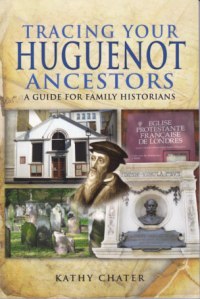
Book Review: Tracing Your Huguenot Ancestors: A Guide for Family Historians by Kathy Chater

Tracing Your Huguenot Ancestors: A Guide for Family Historians by Kathy Chater

I gave four lectures last weekend in Rochester, New York and got a number of questions about tracing Huguenots in England and Ireland, thus I thought appropriate to share this review.

Tracing Your Huguenot Ancestors: A Guide for Family Historians. By Kathy Chater. Published by Pen & Sword Family History, 47 Church Street, Barnsley, South Yorkshire S70 2AS, UK. www.pen-and-sword.co.uk. £12.99. US Distributor: Casemate Publishing, 1016 Warrior Road, Drexel Hill, PA 19026. www.casemateathena.com. US$24.95. Australia sales from Gould Genealogy and History. www.gould.com.au. AUS$29.95. 2012. 152 pp. Illustrations, index. Softcover.

Between the sixteenth and eighteenth centuries many thousands of Protestants fled religious persecution in France and the Low Countries (modern day Belgium, Netherlands and Luxemburg). They settled in the German Protestant States and the British Isles, some permanently while others later migrated to North America, the West Indies, South Africa and Australia. The book opens with a very good summary of the wars and religious conflict that led to these migrations, reminding us just how important religion was in the lives of our ancestors.

The book focusses on the communities within Great Britain and Ireland. It clearly identifies and summarizes the history, development and decline, of the specific Huguenot and Walloon communities in London, Kent, East Anglia, the West Country, Ireland, Scotland and the Channel Islands. Ms. Chater continues by suggesting a research plan with issues to consider. This is not necessarily easy for the wealthy tended to choose to assimilate joining the Church of England, seeking business and education opportunities, while the poor needed the support of their own community. The Huguenot communities could easily be connected with the Church of England or the Dissenting Churches (Congregationalists, Baptists, English Presbyterians) and often with specific occupations so a broad research perspective is required. A nice research checklist is provided of both specific and general sources, with chapters for each. The chapter on specific resources is very valuable addressing: denizations and naturalisations; returns of strangers; Huguenot church records, going beyond the church registers; poor relief and charity records; schools; charity apprenticeships; friendly societies; wills; other foreign churches. What is nice is that these records are not usually high on the priority list for researchers and so their importance and specificity for this community is valuable. The chapter on general sources points to more commonly used records, but again highlights what to look for that might clearly identify people from this community.

The closing chapters address how to research Huguenot communities with individual European countries, and the rest of the world, including briefly North America. The bibliography includes a complete listing of all titles in the Huguenot Society Quarto Series and New Series, plus how the titles have been combined and reissued on CD-ROM, along with a select bibliography.  Compared with other volumes in this series the bibliography and guidance for further research is one of the weaknesses in this otherwise up to date research guide. For example, though the chapter on the religious wars and Edicts in Europe that created this migration is well summarized there is no guidance in the chapter or the bibliography for researchers who want to know more. It should also be pointed out that when discussing the European Huguenot churches mention is made when the records have been microfilmed by the Family History Library, while no mention is made of which British Huguenot church records have been filmed.

This is a useful, up to date, practical guide for anyone who has, or thinks they have, Huguenot ancestors in the British Isles. It provides social and contextual assistance along with guidance on what records have survived, where to find them and how to use them.

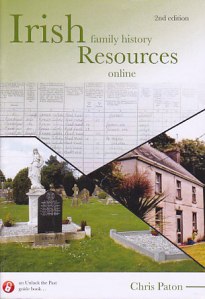
Book Review: Irish Family History Resources Online by Chris Paton

Irish Family History Resources Online, 2nd ed. by Chris Paton

Irish Family History Resources Online. By Chris Paton. Published by Unlock the Past, P.O. Box 675, Modbury, SA 5092, Australia. www.unlockthepast.com.au. 2011. 75 pp. Illustrations, index. Softcover. AUS$19.50.

Online access to indexes and images is growing rapidly for Irish research, often with the same sets of records being available in multiple locations. This book is an expanded adaption of a lecture Mr. Paton gives, it shows and I loved the format and writing style.

The book begins by discussing records to identify who the Irish were, specifically: civil registration; church records; burial records; wills and probate; biographical databases and heraldry. It moves on to examine where the Irish were: censuses; street directories; land records; maps and gazetteers. Further sections address the major archives and libraries, newspapers and books, and a final catchall section covering: gateway sites; military, police and law; emigration; and some miscellaneous sites. The book is not a listing of websites.

So what makes this book different and so useful? Unlike many Irish research books that describe what the records are and contain, this book clearly presents how to search and use the records. For example, in the section on Civil Registration the book clearly shows how to access the indexes using FamilySearch and Ancestry, what different information each provides. It continues by showing how to use the information provided to obtain a certificate or photocopy of the registered birth, marriage or death event through different avenues, with clear suggestions on cheaper alternatives. For the section on Church Records the book online identifies resource guides, commercial and free websites, often outlining their specific strengths, contents, limitations, costs and search techniques.

Throughout the book there are numerous clear color screen captures of numerous websites giving it a lot of visual appeal. All web addresses are in bold so they stand out in the text making them easy to locate and retype into your own browser. The book is also well indexed by subject and location.

This is a book that I intend to keep close and handy to my computer. It is a very practical guide to Irish online research with lots of good practical suggestions.

Upcoming Speaking Events for April 2013

A few of my readers have asked that I specifically mention when and where I am going to be speaking as they would like to come and hear me again. So I will try and do this on an occasional  to highlight upcoming events.

Two upcoming local (Chicago area) events – Tinley Park and Libertyville Public Libraries

4 Apri 2012 Tinley Moraine Genealogists – Tinley Park Public Library, 7851 Timber Drive, Tinley Park, IL 60477,   at 7 p.m. For more info – Tinley Moraine Genealogists

  • English Parish Registers: How to Access, Use and Interpret

23 April 2013 Cook Park Memorial Public Library 413 N. Milwaukee Ave, Livertyville IL 60048, at 7 pm. For more info Cook Memorial Public Library

  • Finding Your Ancestors in Ireland

Two all day Events on the Road – Rochester, New York and Omaha, Nebraska

20 Apr 2013 Rochester Genealogical Society All Day event – A Day of British Genealogy Research with Paul Milner. For more info Rochester Genealogical Society

  • Finding Your English Ancestors: The Big Four
  • Finding Your Scottish Ancestors: The Big Five
  • Buried Treasures: What’s in the English Parish Chest
  • Tracing Your Scots-Irish Ancestors

27 Apr 2013 Greater Omaha Genealogical Society 2013 Spring Genealogy Workshop: Researching Your Irish Ancestors at Nebraska Methodist College, N. 87th & Burth Streets, Omaha, Nebraska. For more info Greater Omaha Genealogical Society

  • Irish Emigration to North America: Before During and After the Famine
  • Finding Your Ancestors in Ireland
  • Irish Maps and Tools for Finding the Right Place
  • Irish Land Records

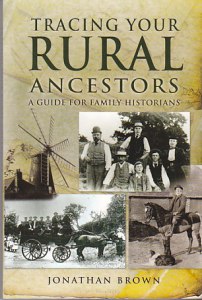
Book Review: Tracing Your Rural Ancestors: A Guide for Family Historians by Jonathan Brown

Tracing Your Rural Ancestors: A Guide for Family Historians by Jonathan Brown

Tracing Your Rural Ancestors: A Guide for Family Historians. By Jonathan Brown. Published by Pen & Sword Family History www.pen-and-sword.co.uk £12.99. US Distributor: Casemate Publishing www.casemateathena.com $24.95. Australia Distributor: Gould Genealogy, www.gould.com.au AUS$32.95 incl GST. 2011. 162 pp. Illustrations, index. Softcover.

Half the population of England and Wales lived in the country in 1851 so it is going to be relatively easy to find rural ancestors on the family tree. At the same time this is a big subject with lots of options for the researcher.

Mr. Brown begins by describing the largest group of rural workers, the farm laborer (1.4 million in the1851 census), looking at what they did, who specialized and who did not, and how their role changed with time. He continues examining who were the farmers, which are not easily defined or identified, and their relationships to the workers, along with a look at the landowners, their great houses and estates. Village life was affected by the different businesses, tradesmen and professionals who lived and worked in any given community, but all left different records to be searched. Another chapter looks at rural migrants and the rural poor. In each of these chapters suggestions are made as to what records will assist in the identifying your rural ancestors.

The largest chapter consists of an alphabetical list of records and source for rural research. This annotated list identifies all the major records you would expect, but also highlights others you may not have heard of or thought of before, such as: copyhold records; enclosure records; farmers’ unions; inquisitions post mortem; rate books; terriers and more. The listing is followed by suggestions on how to identify where the records are located and how to access them, in archives, libraries and online.

One word of caution is that the bibliography states that it “lists all books mentioned in the text together with other suggestions for further reading” (p.145) but this is incorrect for numerous books were recommended within the text that were not included in the bibliography.

Rural ancestry is a large, many faceted topic. This book is a good introduction to the subject socially and genealogically, pointing the reader in the direction of where to find the records and more advanced readings.

James Milner: Convict in Van Dieman’s Land – putting him on the ground

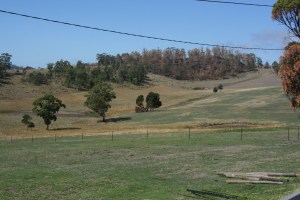
Near Copping
Looking south towards the land of George Frederick Brock Esq, on which resided convict James Milner – Carlton Parish, Tasmania. Yes, those are burned trees on the top of the hill from recent fires in the area

James Milner was sent as a convict in March 1831 aboard the transport ship “Argyle” to Van Diemen’s Land, now Tasmania. I learned about this cousin from Roy Milner a fellow Milner researcher in England. I had verified the details about James Milner using the wonderful convict database at the Archives of Tasmania website.  James was also located in the 1842 census as the head of the household, working as a servant on the land of Fred Brock Esq., located 6 miles from Carlton, in Carlton Parish.

While on my lecture tour in Australia, I learned a lot about the life of convicts and their place in society by reading and visiting a number of prisons. Given the census information I had, I wanted to see if I could physically put James Milner on the ground somewhere in Tasmania. The first stop was the map collection at the Tasmania State library in Hobart where I hit pay dirt. With the help of staff, I located a map of Carlton Parish naming land owners. George Frederick Brock received a land grant of 2560 acres. This has to be Fred Brock, Esq. of the census. More research is needed on this person as he must be significant somehow, especially when one realizes that the largest land grant in Tasmania was 3,000 acres given to the governor, near Richmond. The Brock land abuts the small community of Copping on the modern road from Hobart to the penal settlement at Port Arthur.

This property in many respects was in an ideal location as we had planned on visiting Port Arthur. We had seen advertisements for the Copping Colonial and Convict Museum so we drove to Copping. The name of the museum was a big misnomer and the owner had no information on even the major landowners in the area. We retraced our steps a little along the road until we found a farm track taking us up onto the top of the hill that would give us a great overview, looking South onto the Brock land (see picture). There was no one home at the farm, but I did take a bunch of photographs of the surrounding countryside.

Fred Brock Esq.
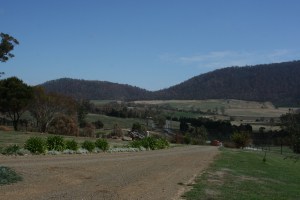
Looking west along main road from Port Arthur to Hobart, just west of Copping. Near land of George Frederick Brock Esq

The census was taken January 3, 1842 at the height of the summer. I was there March 7, thus a little later in the Australian summer. The grass I saw was probably drier and browner, the creek was drier, but the rolling hills, with patches of woodland would have been just as beautiful. Google Earth shows that there are some vineyards or orchards over the crest of the hills to the south but they are not visible from the house where I stood.  There was only one private road, heavily posted with keep out signs, and with lots of truck traffic that appeared to go a little further south onto the property, which had been identified as the municipal tip.  We did not take the private road.

I have James Milner on the ground in Carlton Parish, Tasmania. Now I need to find out more about George Frederick Brock, Esq. for whom he appears to be working. Ah! The joys of family research, always leading to more questions.

Irish Treasure Trove in the News

We can’t get through the Irish celebrations of St. Patrick’s Day without a good Irish story. Here is an excellent article from the New York Times about the personal collection of a fishmonger from Ballina, County Mayo, Ireland that is being cataloged by Sinead McCoole. It’s a job where where she set aside six weeks to catalog and find the best for an exhibition. Now eight years later she is still working on what has become known as the Jackie Clarke Collection with more than a 100,000 items focusing on the retelling of Ireland’s long struggle to free itself of British rule.  The collection includes “fragile maps and rare newspapers, political posters and editorial cartoons, books, diaries, photographs, films and even a scrapbook.”  It’s an interesting story and worth a read. You never know what you might find in your Irish research.

Thanks to Beth Finch McCarthy for bringing this to my attention.

Reflections on an Australian Lecture Tour

I have just returned from four weeks traveling and lecturing in Australia. I was the keynote speaker, giving fifteen lectures and participating in a panel at a genealogy conference on a 9 day cruise out of Sydney. I also gave 4 lectures in each of six cities: Hornsby (Sydney); Brisbane; Perth; Adelaide; Canberra and Melbourne. Everything was wonderfully arranged by Alan Phillips at Unlock the Past.  In total, I presented 39 different lectures on 15 different aspects of British Isles research.

Audience interest met and exceeded our expectations throughout the tour. During the conference, I was gratified to find that people kept coming to my lectures and in fact, began bringing their cruise companions along. During the cities tour, we exceeded attendance expectations, sometimes having double the numbers we expected.

It goes without saying that I had to be well prepared to give 15 different lectures for the cruise, and ensuring that each one was chock full of information.  In point of fact, I had to cut content to meet the 50 minute time limit of the format, since in the U.S. audiences expect a lecture of 60 to 75 minutes. Thank heaven for the power point changer with its built-in timer keeping me on schedule!

Each city venue chose its own four lectures from the fifteen given on the cruise, often with very different subjects to appeal to a wide audience, rather than being chosen to form a cohesive package. Using power point slides meant that I could make adjustments to my presentations while traveling, and thus ensure that the lecture met the specific needs of each audience as we traveled from city to city.

My goal was to make sure that everyone attending learned something new about how to do their own research, and that the beginners did not feel left in the dust. Feedback tells me we succeeded in meeting that goal.

The lectures would not have been so successful without excellent physical arrangements, and for this we thank Unlock the Past.  Venues varied greatly, but were often in clubs (rare to non-existent in the US), such a RSL (Returned Service League), Celtic , Irish, and Broncos (sports team). Major benefits of using the clubs were ample parking and on-site restaurants. Other sites included a town hall and (the best from the presenters’ perspective) the banked auditorium within the State Library of Western Australia.

Events were set up with typical 9-4/5 schedule, but during the week in a 1-9 time slot so that folks could come without missing a whole day of work. Registrants could also choose between a full or half day of presentations, for further flexibility of participation.

Mini lectures on Flip-Pal or Find My Past, given by Rosemary Kopittke, were scheduled in the middle of my four presentations. This was a very smart scheduling move, as it gave me a break. Then, while the audience members had their break, I was 100% focused on answering individual audience questions.

And this brings me to my comments about the audiences I encountered.  Their numbers varied from 80 to 150. Across the board, their base knowledge of general British history, geography and UK genealogical resources was generally far above what I would find in a typical US audience. Many more were themselves or had descended from recent immigrants; therefore, the likelihood that they had traveled extensively in the UK was also much higher than I encounter in the U.S.

I also learned that the standard procedure in Australia is not to provide handouts at the event. I was concerned about this, because it is my practice to provide a content-rich handout so that participants can focus on the examples and do not need to take extensive notes in the lecture. But I found out that it worked well with such a sophisticated audience. I provided the handouts downloadable from this website after the lectures.

Participants were eager for knowledge, case studies, and for resources. They participated actively in the discussions and in the profiling of their needs and interests that I conduct at the beginning of each session. I could readily see that they went away excited and eager to do more research.

It was great fun and a real privilege to lecture to diverse audiences.  My thanks to all! We also made some great new friends along the way.
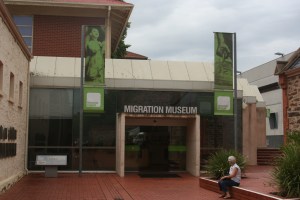
Migration Museum, Adelaide – Puts part of my own life story in perspective

My recent visit to the Migration Museum in Adelaide helped me put part of my own life story in perspective.

From its founding to 1982 Australia has been encouraging and often subsidizing emigrants from the British Isles, especially those with desirable job skills. In 1974 I was a beneficiary of one of these schemes. The Australian government had a program where British college students could be interviewed and apply for summer jobs in Australia. The government would find jobs for the students and then subsidize the flight to Australia.

I did things a little differently. I found my own job in Australia. I then went for an interview, explained that I had found myself a job in my field, and asked if they would subsidize the flight to Australia. They were more than happy to. I thus became one of approximately 100 students who went to Australia for the English summer. I spent two months working underground on a copper and gold mine, working for Peko Mines in Tennant Creek, in the middle of the Northern Territories. I then spent a month touring around Australia learning about this large country.

Visiting the Migration Museum made me appreciate that my journey to Australia, supported by the government, was one way in which they were still encouraging young adults with needed skills to immigrate to Australia.

Migration Museum, Adelaide – A place worth visiting

Entrance to Adelaide Migration Museum

Adelaide’s free Migration Museum — A great place for family historians to visit.

The museum reflects the diverse cultures of South Australia, displaying objects that have a story to tell. The early galleries present the history of early migration into South Australia, highlighting the differences with the other colonies, especially no convicts.  At the same time the museum puts the movement towards a white Australia into a national context. The white Australia policy became official in 1901 after the formation of the Commonwealth of Australia. Britain was unhappy with the white Australia policy because it was a system that denied equality to people within the Empire. To avoid a blatantly racist policy the Australian government introduced a dictation test, adopted from one in use in Natal, whereby a person could be asked to write down or translate a list of 50 words in any European language. The test was used primarily to keep out Asians, but also many Europeans, because any language could be chosen for the test.  Displays pointed out that no one taking the test after 1909 passed, and it remained in use until 1958. Things are very different in Australia now, but it does help to explain the high preponderance of British Isles connections among Australian families. The museum also has displays on the many different ethnic groups that have come to Australia since the ending of its “white policy” rules.

I also enjoyed an exhibit covering John McDouall Stuart’s journeys into the Australian outback in the 1850s and 1860s, when he attempted to find a route from coast to coast. The hardships experienced in the central desert from lack of water, food and sometimes hostile aborigines created a number of failures. He did succeed in 1862 and upon returning to Adelaide he was welcomed as a hero.

Family historians will enjoy visiting this small Adelaide museum dedicated to migration.